
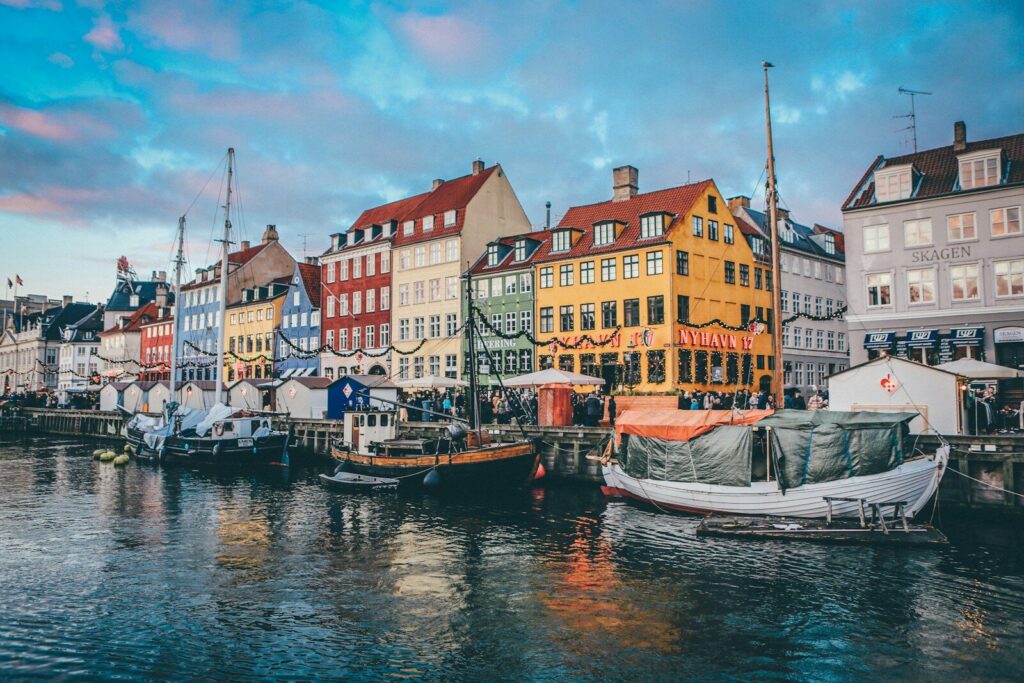
Moving to Denmark from Canada can offer access to a high standard of living, internationally respected public services, excellent cycling infrastructure, efficient urban transportation, strong employment protections, competitive professional opportunities, and a culture that places considerable value on family time, community, trust, and work-life balance.
Denmark attracts Canadians for many different reasons. Some relocate after accepting employment with a Danish technology, pharmaceutical, engineering, renewable-energy, architecture, logistics, manufacturing, maritime, finance, or life-sciences company. Others move to join a spouse, pursue university education, launch an innovative business through Start-up Denmark, conduct research, complete a professional assignment, or experience Scandinavian life.
The country is relatively compact compared with Canada, but it offers a wide range of living environments. Copenhagen is the country’s largest city and main international business centre. Aarhus combines a major university with technology, healthcare, culture, and professional employment. Odense has growing strengths in robotics, automation, healthcare, and education. Aalborg is important for engineering, energy, telecommunications, manufacturing, and university research.
Smaller cities and towns provide access to coastal landscapes, quieter neighbourhoods, shorter commutes, local schools, and regional employment. Denmark also includes the Faroe Islands and Greenland, although their immigration, employment, customs, climate, and relocation conditions differ from mainland Denmark and should be researched separately.
Denmark is a member of the European Union and the Schengen Area, but it does not use the euro. Its currency is the Danish krone, commonly abbreviated DKK.
Canadian citizens can generally visit Denmark and other Schengen countries for up to 90 days within any 180-day period without obtaining a short-stay visa. This permission does not provide unrestricted employment rights or allow a Canadian to settle permanently.
A Canadian intending to work, study, establish a business, join family, or live in Denmark for longer than a permitted short stay generally needs an appropriate residence permit. The correct category must be selected before relocation because different permits provide different employment rights, family rights, renewal conditions, and pathways to permanent residence.
Denmark’s work-permit system includes several important schemes, such as:
- The Pay Limit Scheme
- The Supplementary Pay Limit Scheme
- The Positive List for People with a Higher Education
- The Positive List for Skilled Work
- The Fast-track Scheme
- The Researcher Scheme
- The Special Individual Qualifications Scheme
- Start-up Denmark
- Corporate and training-related permits
The Pay Limit Scheme requires a qualifying Danish job offer with annual remuneration meeting the current statutory threshold. For 2026, the ordinary Pay Limit Scheme threshold is DKK 552,000. The Supplementary Pay Limit Scheme has a lower 2026 threshold of DKK 446,000 but includes additional conditions that do not apply to the ordinary scheme.
Salary thresholds, Positive Lists, processing fees, and administrative procedures can change. Canadians should rely on current information from New to Denmark, the official immigration portal operated by the Danish authorities, rather than older blogs or forum discussions.
This complete guide explains the principal immigration, employment, housing, customs, healthcare, tax, banking, family, education, transportation, and international moving issues involved in moving from Canada to Denmark.
Why Move to Denmark from Canada?
Denmark is frequently associated with quality of life, public infrastructure, social trust, cycling, clean urban design, renewable energy, and a relatively balanced approach to professional and private life.
Canadians commonly consider moving to Denmark for:
- Skilled employment
- Technology careers
- Pharmaceuticals and life sciences
- Engineering
- Renewable energy
- Architecture and design
- Maritime industries
- Logistics
- Scientific research
- University study
- Entrepreneurship
- Family reunification
- Corporate transfer
- Work-life balance
- Public transportation
- Cycling
- Access to Europe
Denmark has several globally important business sectors.
The greater Copenhagen region is strong in:
- Pharmaceuticals
- Biotechnology
- Healthcare
- Financial services
- Information technology
- Clean technology
- Architecture
- Design
- Shipping
- Consulting
- Food science
Aarhus has strengths in:
- Technology
- Education
- Research
- Healthcare
- Food production
- Logistics
- Renewable energy
- Professional services
Odense has developed an international reputation in:
- Robotics
- Automation
- Drones
- Healthcare
- Education
- Manufacturing technology
Aalborg is associated with:
- Engineering
- Telecommunications
- Energy
- Manufacturing
- University research
- Digital industries
Esbjerg is an important centre for:
- Offshore energy
- Wind energy
- Port services
- Shipping
- Logistics
- Oil and gas transition services
Smaller industrial cities can also offer opportunities in manufacturing, food production, energy, construction, logistics, agriculture, and specialized engineering.
Denmark may particularly appeal to professionals who value structured workplaces, relatively flat management, paid vacation, parental benefits, public services, and predictable employment standards.
However, high taxes and high living costs must be considered. Copenhagen housing, restaurants, childcare before subsidies, transportation, imported goods, and personal services can be expensive.
Gross salary should not be compared directly with a Canadian salary without considering:
- Income tax
- Pension contributions
- Holiday allowance
- Employer benefits
- Healthcare
- Transportation
- Housing
- Childcare
- Paid leave
- Work hours
A lower disposable income may be partly balanced by public services and employment benefits, but every household should calculate its own situation carefully.
Important Realities Before Moving
Denmark is often presented as an easy, comfortable, and highly organized destination. It can be an excellent place to live, but newcomers should understand several realities.
Housing can be difficult to secure in Copenhagen and Aarhus. Rental deposits, prepaid rent, and initial housing costs can require a substantial amount of money before move-in.
Danish salaries can be high, but taxation is also high. A generous gross salary may produce a smaller net amount than a newcomer expects.
The Danish language is important. English is widely spoken, especially in international companies and larger cities, but Danish remains necessary for many jobs, local administration, schools, healthcare, social integration, and long-term career development.
Weather can be challenging. Winters are dark, windy, wet, and cool. Temperatures may be milder than in much of Canada, but the combination of darkness, wind, rain, and limited daylight can affect mood and daily routines.
Social relationships can take time to develop. Danish people may be friendly and helpful, but established social circles can be difficult for newcomers to enter without work, school, sports, volunteering, or local clubs.
Immigration permission must be taken seriously. A Danish job offer does not automatically create work authorization, and Canadians should not begin employment until the appropriate permit is valid.
Choosing Where to Live in Denmark
Before selecting a city or municipality, evaluate:
- Place of employment
- Housing costs
- Public transportation
- Cycling distance
- Schools
- Childcare
- Healthcare
- Airport access
- International community
- Danish-language requirements
- Need for a car
- Commuting time
- Coastal exposure
- Flood risk
- Long-term career options
Denmark’s compact geography makes regional commuting possible, but transportation time should not be underestimated.
A home outside Copenhagen may be less expensive, but commuting costs, bridge tolls, train reliability, parking, and time away from family can reduce the savings.
Renting first is generally safer than purchasing immediately. A temporary rental allows newcomers to understand neighbourhoods, public transportation, school districts, winter conditions, and local housing standards.
Moving to Copenhagen
Copenhagen is Denmark’s capital, largest city, and primary international employment market.
Its economy includes:
- Pharmaceuticals
- Biotechnology
- Finance
- Technology
- Shipping
- Architecture
- Design
- Consulting
- Media
- Government
- Research
- Tourism
- Healthcare
- Education
The city attracts a substantial international population. English-speaking positions are more common there than in many smaller Danish communities.
Popular areas include:
- Indre By
- Vesterbro
- Nørrebro
- Østerbro
- Frederiksberg
- Amager
- Christianshavn
- Islands Brygge
- Valby
- Vanløse
- Nordhavn
- Sydhavn
Each neighbourhood offers a different combination of price, transport, nightlife, green space, housing type, family facilities, and commute.
Indre By is central and convenient but expensive.
Vesterbro and Nørrebro offer restaurants, nightlife, cycling access, and urban energy, although some streets can be noisy.
Østerbro and Frederiksberg are popular with families and professionals because of schools, parks, housing quality, and transportation, but rents can be high.
Amager provides access to beaches, newer housing, the airport, metro service, and residential districts.
Nordhavn and Islands Brygge have modern waterfront developments, although newer apartments may command premium prices.
Copenhagen’s public transportation includes:
- Metro
- S-trains
- Regional trains
- Buses
- Harbour buses
- Cycling infrastructure
Many residents commute by bicycle throughout the year.
A car is often unnecessary in central Copenhagen. Parking, registration taxes, fuel, insurance, and congestion can make car ownership expensive.
When viewing housing, inspect:
- Heating
- Insulation
- Windows
- Ventilation
- Mould
- Bicycle storage
- Laundry
- Elevator
- Noise
- Energy rating
- Utility costs
- Registration rights
- Public transportation
Copenhagen is a strong choice for Canadians seeking international employment, urban cycling, cultural life, and access to major employers.
Moving to Aarhus
Aarhus is Denmark’s second-largest city and an important university, technology, healthcare, and cultural centre.
Major sectors include:
- Information technology
- Education
- Research
- Healthcare
- Engineering
- Renewable energy
- Food
- Logistics
- Finance
- Professional services
Aarhus University attracts international students, researchers, and academics.
The city has a compact centre, light rail, buses, cycling infrastructure, beaches, forests, and a substantial student population.
Popular areas include:
- Aarhus C
- Frederiksbjerg
- Trøjborg
- Risskov
- Viby
- Højbjerg
- Aarhus Ø
Central housing can be expensive and competitive.
Aarhus Ø offers modern waterfront apartments but can command high rents. Trøjborg and Frederiksbjerg are popular with students and professionals. Risskov and Højbjerg may appeal to families seeking quieter residential areas.
Aarhus can suit:
- Researchers
- Technology professionals
- Healthcare workers
- Students
- Engineers
- Families
English is common in universities and selected international companies, but Danish is important for local employment and integration.
Moving to Odense
Odense is located on the island of Funen and is Denmark’s third-largest city.
Its economy includes:
- Robotics
- Automation
- Drones
- Healthcare
- Manufacturing
- Education
- Technology
- Logistics
The city is strongly connected to the University of Southern Denmark and a growing robotics cluster.
Odense may appeal to:
- Robotics engineers
- Software developers
- Researchers
- Healthcare professionals
- Students
- Families
Housing is generally more affordable than in central Copenhagen.
The city offers cycling, buses, light rail, universities, hospitals, and rail connections to Copenhagen and Jutland.
Moving to Aalborg
Aalborg is a university and industrial city in northern Jutland.
Important sectors include:
- Engineering
- Energy
- Telecommunications
- Manufacturing
- Information technology
- Research
- Education
- Healthcare
Aalborg University is known for engineering, technology, architecture, and problem-based learning.
Housing can be more affordable than in Copenhagen or Aarhus.
The city may suit:
- Engineers
- Researchers
- Students
- Technology professionals
- Families
Winters can feel colder and windier because of the northern location and exposure.
Moving to Esbjerg
Esbjerg is an important port and energy city on Denmark’s west coast.
Major sectors include:
- Offshore wind
- Energy
- Port services
- Shipping
- Logistics
- Engineering
- Fisheries
- Industrial services
Esbjerg may appeal to:
- Energy professionals
- Marine engineers
- Logistics specialists
- Offshore workers
- Skilled trades
The city is more car-oriented than Copenhagen, although public transportation and cycling are available.
The climate can be windy and wet.
Moving to Roskilde
Roskilde is west of Copenhagen and connected by frequent trains.
It is known for:
- Education
- Research
- Healthcare
- Public administration
- Culture
- Commuter housing
Roskilde may suit professionals who work in Copenhagen but prefer a smaller city.
Housing can still be expensive because of its proximity to the capital.
Moving to Helsingør and North Zealand
North Zealand includes communities such as:
- Helsingør
- Hillerød
- Lyngby
- Holte
- Hørsholm
- Birkerød
The region offers:
- Coastal living
- Forests
- Family homes
- International schools
- Technology and life-science employers
- Commuter access to Copenhagen
Housing can be very expensive in premium northern suburbs.
Some residents commute by train, while others use cars.
Moving to Southern Denmark
Southern Denmark includes cities such as:
- Kolding
- Vejle
- Sønderborg
- Aabenraa
- Haderslev
Industries include:
- Manufacturing
- Engineering
- Logistics
- Energy
- Design
- Education
- Cross-border trade
Sønderborg and the surrounding area have strengths in engineering, energy efficiency, manufacturing, and cross-border business with Germany.
Danish and German can both be useful in southern border areas.
Moving to Smaller Danish Towns
Smaller towns can offer:
- Lower rent
- Larger homes
- Quiet neighbourhoods
- Short local commutes
- Access to nature
- Strong community organizations
Challenges can include:
- Fewer English-speaking jobs
- Limited public transportation
- Need for a car
- Smaller rental market
- Less specialized healthcare
- Greater dependence on Danish
A Canadian moving to a rural or small-town area should visit during winter as well as summer.
Can Canadians Visit Denmark Without a Visa?
Canadian citizens can generally visit Denmark for up to 90 days within a 180-day Schengen period without a visa.
This does not authorize unrestricted employment, permanent residence, or long-term study.
A Canadian planning to work in Denmark generally needs a residence and work permit before beginning employment.
The correct scheme depends on:
- Salary
- Occupation
- Qualifications
- Employer certification
- Research status
- Business plan
- Employment conditions
Applying for a Danish Work Permit
Most work-based residence applications are processed by the Danish Agency for International Recruitment and Integration, commonly known as SIRI.
The employee and employer may each need to complete part of the application.
Common requirements include:
- Passport
- Employment contract
- Job description
- Salary
- Qualifications
- Employer information
- Biometrics
- Application fee
- Supporting documents
A residence and work permit may be tied to:
- Employer
- Position
- Salary
- Duration
- Scheme
- Employment terms
Changing jobs can require a new application.
Do not resign from Canadian employment, ship an entire household, or make irreversible financial commitments without understanding the permit process and likely timeline.
The Pay Limit Scheme
The Pay Limit Scheme allows a third-country national to apply for a residence and work permit when offered a Danish job with annual remuneration meeting the required threshold.
For 2026, the ordinary threshold is DKK 552,000. The qualifying salary and employment terms must satisfy Danish standards and the detailed rules of the scheme.
The applicant’s occupation does not necessarily need to appear on a shortage list.
This can make the scheme useful for:
- Managers
- Technology professionals
- Engineers
- Financial specialists
- Consultants
- Life-sciences professionals
- Senior researchers
- Other high-paid employees
Not every form of compensation counts in the same way toward the salary threshold.
Applicants and employers should confirm how base salary, pension contributions, allowances, bonuses, housing, and other benefits are treated.
The Supplementary Pay Limit Scheme
The Supplementary Pay Limit Scheme provides another route for employees whose annual salary meets a lower statutory amount.
For 2026, the published threshold is DKK 446,000. The scheme has additional conditions, and its rules should not be confused with those of the ordinary Pay Limit Scheme.
Potential additional requirements can relate to:
- Job posting
- Labour-market conditions
- Salary account
- Employer compliance
- Unemployment statistics
- Employment standards
The employer should confirm eligibility before relying on this route.
Positive List for People with a Higher Education
Denmark maintains a Positive List identifying occupations experiencing shortages of qualified professionals.
A Canadian offered a position on the relevant list may qualify for residence and work authorization if the educational and employment requirements are satisfied.
Potential fields may include selected positions in:
- Engineering
- Healthcare
- Information technology
- Science
- Education
- Finance
- Management
- Social services
The list is updated, and the exact occupation, educational level, and professional authorization requirements must be checked at the time of application.
A similar job title is not always enough. The position must match the applicable classification and qualification requirements.
Positive List for Skilled Work
Denmark also maintains a Positive List for Skilled Work covering selected occupations where qualified workers are needed.
The list can include occupations in areas such as:
- Skilled trades
- Construction
- Industrial production
- Technical services
- Healthcare support
- Food services
- Transport
- Specialized manual work
The official list and wage statistics are updated periodically. The current official page notes wage statistics for the Positive List for Skilled Work valid from February 2026.
Applicants may need:
- Relevant vocational qualification
- Employment contract
- Appropriate salary
- Danish authorization where required
- Documented experience
The Fast-track Scheme
The Fast-track Scheme is designed for employers certified by SIRI.
It can provide a more streamlined process for qualifying employees working for certified companies.
Tracks can include:
- Pay limit track
- Supplementary pay limit track
- Researcher track
- Educational track
- Short-term track
The scheme can be valuable for multinational employers, research institutions, and companies that recruit international specialists regularly.
For 2026, the pay limit track uses the DKK 552,000 salary threshold.
The employer must be certified. A job with a non-certified employer cannot simply be processed through Fast-track.
Researcher Scheme
Researchers who have been offered qualifying research employment may apply through a specialized route.
Potential employers include:
- Universities
- Public research institutions
- Hospitals
- Private research companies
- Pharmaceutical businesses
- Technology laboratories
Applicants may need:
- Employment contract
- Research position
- Salary documentation
- Qualifications
- Host information
- Insurance
- Passport
The scheme may provide favourable conditions for qualifying researchers and accompanying family members.
Special Individual Qualifications
A person may qualify where a specific position is closely connected to the applicant’s individual qualifications.
This can be relevant to:
- Artists
- Performers
- Athletes
- Chefs with specialized expertise
- Coaches
- Other uniquely qualified professionals
The applicant and employer must demonstrate why the person’s individual background is essential to the position.
Start-up Denmark
Start-up Denmark is intended for innovative entrepreneurs whose business concepts are approved by an expert panel.
The route is not intended simply for opening an ordinary retail business, consultancy, restaurant, or small local service.
Applicants generally need:
- Innovative business concept
- Expert-panel approval
- Active involvement
- Financial resources
- Business documentation
- Ability to support themselves
A successful applicant may receive residence and work authorization to operate the approved business.
Accompanying family members can generally apply for residence connected to the principal applicant, and official extension guidance confirms that accompanying family can extend alongside a Start-up Denmark permit holder.
Entrepreneurs should also plan for:
- Company formation
- Tax registration
- VAT
- Banking
- Accounting
- Payroll
- Insurance
- Employment law
- Intellectual property
- Financing
Working Holiday and Youth Mobility
Canada and Denmark have youth mobility arrangements that may allow eligible young Canadians to live and work temporarily in Denmark.
The program may suit Canadians who want to:
- Travel
- Experience Danish culture
- Learn Danish
- Take temporary employment
- Build international experience
- Evaluate future relocation
Applicants should confirm current:
- Age limits
- Quotas
- Financial requirements
- Insurance
- Passport validity
- Application procedure
- Employment restrictions
- Program duration
A working holiday is temporary and does not automatically create permanent residence.
Student Residence Permit
Canadians admitted to a qualifying Danish educational institution may apply for residence for study.
Applicants may need:
- Admission letter
- Tuition evidence
- Proof of funds
- Passport
- Biometrics
- Health coverage where required
- Accommodation information
- Application fee
Denmark offers universities and institutions in Copenhagen, Aarhus, Odense, Aalborg, Roskilde, and other cities.
Programs may be available in English, especially at graduate level.
Students should confirm:
- Tuition
- Work rights
- Academic-progress requirements
- Permit duration
- Job-search period
- Housing
- Family rights
- Health coverage
A student permit does not automatically provide unrestricted full-time employment.
Accompanying Family Members
A spouse, registered partner, cohabiting partner, or qualifying child may be able to accompany a person moving to Denmark for work or study.
The rules for accompanying family are different from the general family-reunification rules used when joining a Danish citizen or permanent resident.
Accompanying family members of many work-permit holders can receive residence for the same general period as the principal applicant.
In many cases, an accompanying spouse or partner can work in Denmark, although the exact rights should be confirmed on the permit.
Official guidance for accompanying family members notes that adults with a registered Danish address may be entitled to Danish lessons.
Required documents may include:
- Marriage certificate
- Proof of cohabitation
- Birth certificates
- Passports
- Principal applicant’s permit
- Financial evidence
- Accommodation
- Custody documents
- Translations
Family Reunification with a Danish Citizen or Permanent Resident
A Canadian spouse or cohabiting partner of a Danish citizen or qualifying resident may apply through Denmark’s family-reunification rules.
These rules can be strict.
Requirements may involve:
- Valid marriage or qualifying cohabitation
- Age
- Housing
- Financial guarantee
- Integration
- Language
- Employment
- Visits to Denmark
- Attachment requirements
- No disqualifying public assistance
- Residence status of the sponsor
The current official page for spousal family reunification lists a maximum expected processing time of 10 months and a 2026 application fee of DKK 8,490, although fees and processing times can change.
Applicants should use the official checklist for their circumstances.
EU Family Rules
A Canadian family member of an EU or EEA citizen living in Denmark may qualify under EU free-movement rules if the sponsor meets the applicable conditions as a worker, student, self-employed person, or self-supporting person.
Official guidance states that the sponsor must hold qualifying EU residence in Denmark and the applicant must have the required family relationship.
EU rules differ from Denmark’s national family-reunification rules.
Job-Seeking Rights After Job Loss
Certain work-permit holders may be eligible for a temporary job-seeking permit if they lose employment through no fault of their own.
Eligible categories can include holders under:
- Positive List for People with a Higher Education
- Pay Limit Scheme
- Researcher Scheme
- Specified Fast-track tracks
Official guidance indicates that qualifying workers may apply for a permit allowing up to six months to seek new employment after involuntary job loss.
The application must normally be submitted promptly.
Do not assume every permit provides this protection.
Permanent Residence in Denmark
Permanent residence can provide the right to remain in Denmark without dependence on a temporary work, study, or family permit.
Requirements can be demanding.
Potential conditions include:
- Minimum years of lawful residence
- Employment history
- Danish-language ability
- No serious criminal record
- Limited receipt of certain public benefits
- Financial independence
- Active citizenship or community involvement
- Passing relevant examinations
- Continuing residence
Some applicants may qualify sooner if they meet additional supplementary requirements.
Time spent under certain permits may be treated differently.
Plan for permanent residence early by:
- Learning Danish
- Maintaining legal employment
- Avoiding permit gaps
- Keeping tax records
- Following residence rules
- Tracking travel outside Denmark
- Retaining official documents
Danish Citizenship
Citizenship is separate from permanent residence.
Naturalization can involve:
- Long period of residence
- Permanent residence
- Danish-language ability
- Citizenship test
- Financial self-support
- Employment requirements
- Clean criminal record
- Loyalty declaration
- Participation in a municipal ceremony
Denmark permits dual citizenship, but applicants should confirm how Danish and Canadian rules apply to their circumstances.
Preparing Canadian Documents
Document preparation should begin early.
Possible documents include:
- Passport
- Birth certificate
- Marriage certificate
- Divorce judgment
- Criminal record check
- University diploma
- Transcripts
- Professional licence
- Employment references
- Employment contract
- Proof of salary
- Business plan
- Bank statements
- Family documents
- Custody documents
Documents may require:
- Apostille
- Certified translation
- Original copy
- Certified copy
- Notarization
- Recent issue date
Canada has participated in the Apostille Convention since January 2024.
The responsible apostille authority depends on where the Canadian document was issued or notarized.
Danish authorities may accept documents in Danish or English in some procedures, but requirements vary.
Maintain:
- Originals
- Apostilles
- Translations
- Copies
- Digital scans
- Application receipts
Biometrics
Residence applicants may be required to provide:
- Photograph
- Fingerprints
- Signature
Biometrics must generally be completed within the required time after submission.
Failure to complete biometrics correctly can affect the application.
Registering in Denmark
After moving and obtaining lawful residence, newcomers generally need to register in Denmark’s Civil Registration System.
The CPR number is central to Danish daily life.
It is used for:
- Healthcare
- Tax
- Employment
- Banking
- Housing
- Schools
- Childcare
- Digital services
- Insurance
Registration requirements generally involve:
- Lawful residence
- Danish address
- Expected length of stay
- Passport
- Residence permit
- Housing documentation
After CPR registration, residents may receive a health card and access to other public systems.
MitID and Digital Post
Denmark uses extensive digital government services.
MitID is commonly used for:
- Banking
- Tax
- Healthcare
- Government communication
- Insurance
- Contracts
- Public benefits
Residents also receive official electronic correspondence through Digital Post.
Check Digital Post regularly. Important deadlines, tax notices, healthcare information, and immigration correspondence may be delivered electronically.
How Much Does It Cost to Move to Denmark from Canada?
The total cost depends on:
- Canadian origin
- Danish destination
- Family size
- Permit category
- Shipment volume
- Housing
- Pets
- Vehicles
- Schooling
- Insurance
- Professional services
Potential expenses include:
- Residence application fees
- Biometrics
- Police records
- Apostilles
- Translations
- Flights
- International shipping
- Export packing
- Sea freight
- Air freight
- Customs clearance
- Storage
- Temporary housing
- Rental deposit
- Prepaid rent
- Furniture
- Utility setup
- Pet relocation
- Vehicle expenses
- School tuition
- Emergency savings
Housing startup costs can be particularly high.
A Danish landlord may request:
- Deposit
- Prepaid rent
- First month’s rent
- Utility advance
Together, these amounts can equal several months of rent.
International Moving Costs
International movers calculate costs according to:
- Shipment volume
- Weight where applicable
- Packing
- Canadian origin
- Danish destination
- Container type
- Shipping route
- Customs
- Storage
- Insurance
- Building access
Denmark has major ports and efficient connections to Northern Europe.
A shipment from Toronto, Montreal, Ottawa, or Halifax may follow a different route from one originating in Vancouver, Calgary, Edmonton, or Winnipeg.
Final-delivery charges can increase where there are:
- Narrow streets
- Limited parking
- Pedestrian zones
- Small elevators
- Stair carries
- Long carries
- External lifts
- Shuttle vehicles
- Municipal permits
Ask for a professional survey before accepting a final quotation.
Shipping Household Goods to Denmark
Sea freight is usually the most economical choice for a substantial household relocation.
Options include:
- Shared-container shipping
- Full-container shipping
- Air freight
- Excess baggage
- Courier service
- Storage
- Vehicle shipping
- Door-to-door service
Shared-Container Shipping
Shared-container shipping allows multiple households to use one container.
You pay for the volume occupied by your shipment.
It may suit:
- Apartment moves
- Partial households
- Students
- Retirees
- Furnished-home moves
- Smaller families
The main disadvantage is timing.
The mover may wait for other cargo before departure.
Ask:
- How often containers leave
- Where consolidation occurs
- Whether goods are transferred
- When transit time begins
- Which port is used
- Whether customs is included
- Whether destination charges are included
- Whether storage is included
Full-Container Shipping
A full container is dedicated to one household.
It may suit:
- Families
- Larger homes
- Extensive furniture
- Significant personal belongings
- Customers seeking more scheduling control
Common options include 20-foot and 40-foot containers.
A professional survey should estimate the volume.
Decluttering reduces:
- Packing costs
- Freight
- Insurance
- Storage
- Customs handling
- Final delivery
Air Freight
Air freight is faster but more expensive.
It may be suitable for:
- Work equipment
- Computers
- Essential clothing
- Medical supplies
- Children’s necessities
- Time-sensitive possessions
Many families travel with essential luggage, send a small air shipment, and move the main household contents by sea.
What Should You Ship?
Danish apartments and houses may be smaller than Canadian homes.
Before shipping furniture, evaluate:
- Room dimensions
- Door widths
- Staircases
- Elevator size
- Storage
- Building access
- Electrical compatibility
- Replacement cost
Items often worth shipping include:
- Sentimental possessions
- Artwork
- High-quality furniture
- Books
- Clothing
- Heirlooms
- Professional equipment
- Children’s belongings
- Collections
Items often better sold or donated include:
- Oversized sectional furniture
- Large Canadian appliances
- Old electronics
- Low-value furniture
- Damaged goods
- Electrically incompatible equipment
Denmark uses European voltage, frequency, and plugs.
A plug adapter does not convert voltage.
Check every electrical item before shipping.
Professional Export Packing
International shipments undergo more handling than domestic moves.
Professional packing may include:
- Double-walled cartons
- Furniture wrapping
- Mattress covers
- Moisture protection
- Wardrobe cartons
- Foam
- Reinforced tape
- Corner protection
- Custom crates
Artwork, mirrors, antiques, instruments, stone, and high-value electronics may require custom crating.
Ask how owner-packed cartons affect insurance.
Danish Customs Relief for Moving Goods
Used personal property imported when transferring normal residence from Canada to Denmark may qualify for relief from customs duty and VAT when the applicable conditions are met.
The Danish Customs Agency explains that moving goods from a non-EU country can qualify for customs and VAT relief under residence-transfer rules. Its official declaration form indicates that the person generally must have had their normal residence outside the EU for a continuous period of at least 12 months.
Potential requirements include:
- Previous residence outside the EU
- Ownership and use before relocation
- Personal use after import
- Import within the required period
- Transfer of normal residence
- Accurate declaration
- No prohibited disposal after clearance
No relief is generally granted for categories such as alcohol, tobacco, commercial means of transport, or articles intended for professional trade or occupation.
Your mover or customs broker may request:
- Passport
- Residence permit
- CPR or registration evidence
- Danish lease
- Proof of Canadian residence
- Employment or study documents
- Detailed inventory
- Shipping documents
- Customs declaration
- Authorization for representation
- Evidence of ownership and use
Preparing the Customs Inventory
Create a detailed numbered inventory.
Avoid vague descriptions such as:
- Miscellaneous
- Household goods
- Personal items
- Various effects
Use descriptions such as:
- Used clothing
- Books
- Kitchen utensils
- Bedding
- Used tableware
- Children’s toys
- Framed photographs
- Decorative objects
- Office records
- Used furniture
List valuable items separately.
Record serial numbers.
Take photographs before packing.
Keep receipts and appraisals for high-value belongings.
Restricted and Prohibited Goods
Do not pack hazardous or prohibited items.
Restricted categories may include:
- Firearms
- Ammunition
- Explosives
- Fireworks
- Fuel
- Gas cylinders
- Chemicals
- Paint
- Aerosols
- Illegal drugs
- Certain medicines
- Plants
- Seeds
- Soil
- Meat
- Dairy
- Protected wildlife products
- Counterfeit goods
Denmark applies special rules to regulated products and goods entering from outside the European Union. Travellers must declare goods subject to customs duty, VAT, or excise duties and should use the red channel where required or when uncertain.
Medication should generally travel with you in original packaging with prescription and physician documentation.
Importing a Canadian Vehicle
Importing a Canadian vehicle into Denmark can be extremely expensive.
Potential expenses and requirements include:
- Shipping
- Customs
- Import VAT
- Registration tax
- Technical inspection
- Modifications
- Emissions compliance
- Insurance
- Licence plates
- Annual taxes
Denmark’s vehicle registration taxes can be substantial.
Even where a vehicle qualifies as relocation property for customs purposes, registration tax and technical requirements may still apply.
Canadian vehicles may be difficult to:
- Register
- Modify
- Insure
- Repair
- Resell
For many Canadians, selling the vehicle before departure and purchasing or leasing a vehicle in Denmark is simpler.
Moving Pets to Denmark
Dogs, cats, and ferrets entering Denmark from Canada must comply with European Union animal-entry requirements.
The process may include:
- Microchip
- Rabies vaccination
- Veterinary health certificate
- Approved entry route
- Identity inspection
- Airline-compliant crate
- Supporting records
The animal generally must be microchipped before or at the same time as the qualifying rabies vaccination.
Begin the process several months before travel.
Pet-relocation costs can include:
- Veterinary visits
- Microchip
- Vaccinations
- Health certificate
- Crate
- Airline fees
- Cargo handling
- Ground transportation
- Boarding
- Pet-friendly accommodation
Denmark has restrictions involving certain dog breeds and crossbreeds.
Dog owners should verify breed eligibility before arranging travel.
After arrival, owners may need to address:
- Dog registration
- Identification
- Liability insurance
- Veterinary care
- Lease permission
- Municipal rules
International Moving Insurance
Marine transit insurance can protect eligible household belongings during transportation.
Options may include:
- Total-loss coverage
- Declared-value coverage
- Replacement-value coverage
- High-value item coverage
- Limited owner-packed coverage
Review:
- Deductible
- Exclusions
- Valuation
- Storage coverage
- Moisture exclusions
- Mould exclusions
- Claims deadlines
- Evidence requirements
Do not ship:
- Passports
- Cash
- Jewellery
- Medication
- Financial instruments
- Irreplaceable documents
Finding Housing in Denmark
Housing is one of the most difficult and expensive parts of relocating to Denmark.
Landlords may request:
- Passport
- Residence documentation
- Employment contract
- Payslips
- Bank statements
- Deposit
- Prepaid rent
- References
Newcomers without Danish income or credit history may need to provide:
- Employment contract
- Employer relocation letter
- Canadian bank statements
- Guarantor
- Larger documentation package
Temporary accommodation can provide time to inspect properties.
Understanding Danish Rental Listings
Common Danish terms include:
- Lejlighed: apartment
- Hus: house
- Værelse: room
- Husleje: rent
- Depositum: deposit
- Forudbetalt leje: prepaid rent
- Aconto: advance utility payment
- Møbleret: furnished
- Umøbleret: unfurnished
- Varme: heating
- El: electricity
- Vand: water
- Indflytningsdato: move-in date
- Boligareal: living area
Clarify whether the advertised rent includes:
- Heating
- Water
- Electricity
- Internet
- Building charges
- Parking
- Laundry
- Waste
Deposits and Prepaid Rent
A Danish landlord may lawfully request a deposit and prepaid rent within applicable limits.
Combined with the first month’s rent, the upfront amount can be substantial.
Before paying:
- Verify the landlord
- Confirm ownership or authority
- Review the lease
- Inspect the property
- Document condition
- Record meter readings
- Obtain receipts
- Confirm CPR registration rights
Move-In and Move-Out Condition
Document the property carefully at move-in.
Use:
- Photographs
- Video
- Written defect list
- Meter readings
- Key inventory
- Furniture inventory
Report defects immediately within the lease’s required timeframe.
Danish move-out standards can be strict, and landlords may charge for painting, floors, cleaning, or repairs where permitted.
Housing Cooperatives
Denmark has cooperative housing known as andelsbolig.
Purchasing a cooperative share is different from buying a conventional freehold condominium.
Buyers should review:
- Association debt
- Monthly charges
- Valuation
- Subletting rules
- Renovation obligations
- Financing
- Waiting lists
Non-residents and newcomers may face financing and eligibility challenges.
Rental Scams
Warning signs include:
- Rent far below market value
- Landlord refusing a viewing
- Owner claiming to be abroad
- Pressure to transfer money
- No written lease
- Cryptocurrency request
- Copied photographs
- Refusal to provide identification
- Refusal to allow CPR registration
Verify the property, landlord, contract, and payment details before paying.
Buying Property in Denmark
Non-EU citizens can face restrictions when purchasing Danish property.
Permission may be required if the buyer does not have a qualifying period of residence or other sufficient connection to Denmark.
Special restrictions can apply to:
- Holiday homes
- Summer houses
- Coastal properties
- Agricultural property
Use independent professionals, including:
- Lawyer
- Buyer adviser
- Building inspector
- Surveyor
- Tax adviser
- Mortgage adviser
Investigate:
- Title
- Mortgages
- Easements
- Building condition
- Energy rating
- Flood exposure
- Roof
- Foundation
- Moisture
- Heating
- Renovations
- Homeowners’ association
- Property taxes
Property ownership does not automatically provide immigration rights.
Healthcare in Denmark
Denmark has a tax-funded public healthcare system.
Residents who are lawfully registered and receive a CPR number are generally enrolled in the public system and receive a health card.
The health card identifies the resident’s assigned general practitioner.
Public healthcare includes access to:
- General practitioners
- Specialists through referral
- Hospitals
- Emergency care
- Maternity care
- Preventive services
- Subsidized prescriptions
Dental care for adults is not fully covered in the same way as general medical care.
Some residents purchase supplementary insurance for:
- Dental care
- Physiotherapy
- Prescriptions
- Private treatment
- Faster access
Before leaving Canada, obtain:
- Medical records
- Vaccination history
- Prescription list
- Specialist reports
- Diagnostic results
- Dental records
- Vision prescription
- Physician letters
Bring medication in original packaging.
Canadian Provincial Healthcare
Do not assume Canadian provincial healthcare will continue after permanent relocation.
Each province has residency and absence requirements.
Contact the provincial health authority before departure.
Travel insurance may not be appropriate for permanent residence.
Taxes When Moving to Denmark
Cross-border tax planning is essential.
Danish tax residence can arise through:
- Establishing a home
- Spending sufficient time in Denmark
- Beginning work
- Family residence
- Centre of personal and economic interests
Danish tax residents may be taxed on worldwide income.
Potentially relevant income and assets include:
- Danish salary
- Canadian employment income
- Remote-work income
- Pensions
- Rental income
- Interest
- Dividends
- Capital gains
- Business income
- Corporate interests
- Trusts
- Cryptocurrency
- Foreign property
Canada and Denmark have a bilateral income tax convention intended to allocate taxing rights and reduce double taxation.
The treaty does not remove every filing, withholding, or disclosure obligation.
Canadians leaving Canada may need to consider:
- Departure date
- Residential ties
- Departure tax
- Canadian real estate
- Pensions
- Registered accounts
- Investments
- Corporations
- Trusts
- Non-resident withholding
- Provincial obligations
Use advisers experienced with both Canadian and Danish tax.
Danish Income Tax
Danish income taxation can include:
- State tax
- Municipal tax
- Labour-market contribution
- Church tax where applicable
- Other assessments
Denmark has progressive taxation.
Ask employers for a realistic net-pay estimate.
Compensation may include:
- Employer pension
- Holiday entitlement
- Bonus
- Phone
- Internet
- Company car
- Health insurance
- Meal arrangements
- Relocation support
Do not compare gross salaries without examining the complete package.
Researcher and Highly Paid Employee Tax Scheme
Some qualifying researchers and highly paid foreign employees may be eligible for a special expatriate tax scheme for a limited period.
Eligibility depends on detailed conditions involving:
- Salary
- Employment history
- Employer
- Prior Danish tax residence
- Research status
- Timing
This is a tax regime, not a residence permit.
Immigration eligibility and tax eligibility must be reviewed separately.
Remote Work and Danish Tax
Working remotely from Denmark for a Canadian employer can create obligations involving:
- Danish income tax
- Canadian income tax
- Payroll
- Social security
- Employment law
- Employer registration
- Permanent establishment
- Corporate management
Being paid into a Canadian bank account does not prevent Danish taxation.
A Canadian employer may acquire Danish obligations when an employee works from Denmark regularly.
Business owners managing Canadian companies from Denmark should obtain specialized corporate tax advice.
Social Security Coordination
Canada and Denmark have a social-security agreement coordinating parts of the two countries’ pension systems.
Canada’s official guidance states that the agreement covers the Canada Pension Plan and Old Age Security, and that Danish contribution periods may help a person qualify for Canadian benefits in certain circumstances.
Canada also provides a certificate-of-coverage form for employed and self-employed persons under the agreement.
The agreement can help address:
- Pension eligibility
- Contribution periods
- Temporary assignments
- Duplicate coverage
It does not make the two systems identical.
Opening a Danish Bank Account
A Danish bank account can simplify:
- Salary
- Rent
- Utilities
- Taxes
- Insurance
- Mobile service
- Digital payments
Banks may request:
- Passport
- CPR number
- Residence permit
- Address
- Employment contract
- Tax information
- Source-of-funds evidence
Compare:
- Monthly fees
- Debit card
- Online banking
- English support
- International transfers
- Foreign-exchange charges
- Mortgage options
Keep a Canadian account for pensions, investments, taxes, property, and continuing obligations.
NemKonto
Residents generally designate a bank account as their NemKonto.
Government payments, tax refunds, and certain public transfers are sent to this account.
Transferring Money to Denmark
Compare the total amount received after:
- Exchange-rate margin
- Transfer fee
- Intermediary fee
- Receiving-bank fee
- Transfer limit
- Processing time
Large transfers may trigger source-of-funds checks.
Verify property, rental, or business payment instructions through a second communication channel.
Working in Denmark
Denmark has employment opportunities in:
- Pharmaceuticals
- Biotechnology
- Information technology
- Engineering
- Renewable energy
- Shipping
- Logistics
- Architecture
- Design
- Finance
- Healthcare
- Food science
- Robotics
- Research
- Construction
- Skilled trades
Copenhagen offers the broadest international employment market.
Aarhus is strong in technology, research, healthcare, energy, and food.
Odense is a centre for robotics and automation.
Aalborg has engineering, energy, telecommunications, and research.
Esbjerg is important for offshore and wind-energy activity.
Danish Workplace Culture
Danish workplaces are often associated with:
- Flat hierarchies
- Informal communication
- Punctuality
- Independent responsibility
- Team collaboration
- Work-life balance
- Direct feedback
- Employee participation
Titles may be used less frequently than in some countries.
Employees are expected to manage responsibilities independently and communicate openly.
Working late is not always viewed as a sign of commitment. Efficient work and respect for personal time are often valued.
Professional Credential Recognition
Regulated professions may require recognition of Canadian qualifications.
This can apply to:
- Doctors
- Nurses
- Dentists
- Pharmacists
- Teachers
- Lawyers
- Architects
- Engineers in regulated settings
- Psychologists
- Physiotherapists
- Skilled trades
Applicants may need:
- Diploma
- Transcripts
- Course descriptions
- Professional registration
- Employment references
- Apostilles
- Certified translations
- Examinations
- Danish-language evidence
- Adaptation training
Immigration permission does not automatically authorize professional practice.
Learning Danish
English is widely spoken, but Danish is important for:
- Employment
- Healthcare
- Schools
- Government communication
- Housing
- Social integration
- Permanent residence
- Citizenship
- Career advancement
Danish pronunciation can be challenging even for people who can read the language.
Begin before departure and focus on:
- Numbers
- Dates
- Addresses
- Medical vocabulary
- Housing
- Transportation
- Banking
- Work
- Emergencies
Residents with qualifying status and a registered address may be entitled to Danish lessons, although deposits, participation rules, or local procedures can apply.
Moving with Children
Families should research schools before choosing housing.
Denmark offers:
- Public schools
- Private schools
- International schools
- Bilingual programs
- Boarding schools
- Vocational education
- Universities
Public schools primarily teach in Danish.
International schools are concentrated in Copenhagen, North Zealand, Aarhus, Billund, Odense, Aalborg, and selected other locations.
Tuition can be substantial, although some schools receive subsidies.
Bring:
- Birth certificates
- Passports
- Vaccination records
- School reports
- Transcripts
- Special-education documentation
- Custody records
- Apostilles
- Translations
School placement can depend on:
- Address
- Age
- Danish ability
- Academic history
- Availability
- Municipality
Childcare
Denmark has an extensive childcare system, but availability and waiting times vary.
Options include:
- Daycare
- Nursery
- Kindergarten
- Childminders
- Private care
Municipal subsidies can reduce costs for eligible residents.
Apply early, especially in Copenhagen and other high-demand municipalities.
Transportation in Denmark
Denmark has extensive transportation options.
These include:
- Intercity trains
- Regional trains
- Metro
- S-trains
- Light rail
- Buses
- Ferries
- Cycling
- Domestic flights
- Private vehicles
Cycling is a major part of everyday transportation.
Residents should invest in:
- Reliable bicycle
- Lights
- Locks
- Rain gear
- Winter clothing
- Helmet
- Reflective equipment
Driving in Denmark
Canadians should verify the current rules for using or exchanging their provincial driving licence.
Requirements can depend on:
- Province
- Residence status
- Licence validity
- Application timing
- Medical requirements
- Written test
- Driving test
Driving costs include:
- Vehicle purchase
- Registration tax
- Insurance
- Fuel
- Parking
- Bridge tolls
- Maintenance
- Annual taxes
A car may be unnecessary in Copenhagen but useful in rural areas and smaller cities.
Climate
Denmark has a temperate maritime climate.
Winters are often:
- Dark
- Windy
- Wet
- Cloudy
- Cool
Snow occurs, but heavy long-term snow is less common than in much of Canada.
Summers are generally mild, although heat waves can occur.
Coastal weather can change quickly.
When inspecting housing, evaluate:
- Heating
- Insulation
- Windows
- Ventilation
- Moisture
- Mould
- Flood exposure
- Coastal wind
- Energy rating
Everyday Cultural Adjustment
Canadians may notice:
- Strong cycling culture
- Direct communication
- Informal workplaces
- Punctuality
- High digitalization
- Cashless payments
- Quiet residential expectations
- Extensive recycling
- Strong associations and clubs
- Early planning of social events
- Respect for personal time
Joining clubs, sports groups, language classes, volunteer organizations, and parent networks can help newcomers build social connections.
A Complete Moving Timeline
Twelve Months Before Moving
Research:
- Work-permit schemes
- Positive Lists
- Pay Limit Scheme
- Fast-track
- Start-up Denmark
- Cities
- Housing
- Tax
- Healthcare
- Schools
- Shipping
- Pets
Create a budget and begin decluttering.
Nine Months Before Moving
Gather:
- Passports
- Birth certificates
- Marriage certificates
- Criminal record documents
- Academic credentials
- Employment references
- Medical records
- School records
- Pet records
Begin learning Danish.
Six Months Before Moving
- Confirm the permit route
- Obtain tax advice
- Request moving surveys
- Research housing
- Arrange apostilles
- Arrange translations
- Prepare pets
- Review insurance
- Decide what to ship
- Begin credential recognition
Three Months Before Moving
- Submit the residence application
- Confirm employment authorization
- Select the mover
- Finalize shipment volume
- Reserve flights
- Book temporary accommodation
- Prepare customs documentation
- Sell unwanted belongings
- Notify employers and schools
One Month Before Moving
- Confirm packing
- Refill prescriptions
- Back up computers
- Redirect mail
- Notify banks
- Cancel utilities
- Copy documents
- Prepare luggage
- Confirm destination contacts
- Review customs timing
Final Week
Keep these items away from the movers:
- Passports
- Residence documents
- Employment contract
- Medication
- Money
- Jewellery
- Computers
- Chargers
- Customs papers
- School records
- Pet records
- Travel clothing
Inspect every room, garage, basement, attic, and storage locker.
First Week in Denmark
- Move into temporary accommodation
- Complete residence formalities
- Register for a CPR number
- Obtain a Danish phone number
- Contact the destination mover
- Begin long-term housing searches
- Arrange healthcare registration
- Learn local transportation
First Month
- Receive residence documentation
- Secure permanent housing
- Obtain MitID
- Open a bank account
- Designate NemKonto
- Register for tax
- Set up utilities
- Enrol children
- Receive the household shipment
- Establish a monthly budget
Common Mistakes to Avoid
Assuming Visa-Free Entry Allows Work
A Canadian short-stay exemption does not provide unrestricted employment rights.
Choosing the Wrong Work Scheme
The Pay Limit Scheme, Supplementary Pay Limit Scheme, Positive Lists, Fast-track, and researcher routes have different requirements.
Beginning Work Before Approval
Do not start employment until authorization is valid.
Underestimating Housing Startup Costs
Deposits, prepaid rent, and the first month’s rent can require substantial cash.
Ignoring Danish
English may be sufficient at work, but Danish is important for long-term integration and career mobility.
Underestimating Tax
Danish gross salary can differ significantly from take-home pay.
Shipping Too Much
Large Canadian furniture and appliances may not suit Danish homes.
Importing a Vehicle Without Research
Registration tax and technical requirements can make vehicle importation uneconomical.
Renting Without CPR Registration Rights
A legal Danish address is essential for many administrative processes.
Choosing Movers Only by Price
A low quotation may exclude customs, port handling, stairs, permits, storage, shuttles, or final delivery.
Frequently Asked Questions
Can a Canadian live permanently in Denmark?
Yes. Canadians can qualify through employment, family, study, business, research, or another lawful category. Permanent residence requires meeting separate long-term conditions.
Can Canadians visit Denmark without a visa?
Canadian citizens can generally visit Denmark and the Schengen Area for up to 90 days within a 180-day period. This does not provide unrestricted work rights.
Can Canadians work in Denmark?
Yes, with an appropriate residence and work permit.
What is the Pay Limit Scheme?
It is a work-permit route for applicants with qualifying Danish employment and annual remuneration meeting the statutory threshold. The 2026 threshold is DKK 552,000.
What is the Supplementary Pay Limit Scheme?
It is a separate work route with a lower salary threshold and additional conditions. The 2026 threshold is DKK 446,000.
What is the Positive List?
The Positive Lists identify occupations where Denmark is experiencing shortages of qualified workers. Separate lists exist for higher-education occupations and skilled work.
Can a spouse work in Denmark?
Accompanying spouses of many work-permit holders can receive residence and work rights, but the exact permit should be reviewed.
Can Canadians start a business?
Yes. Innovative entrepreneurs may qualify through Start-up Denmark, while other businesses require a suitable immigration and corporate structure.
Does Denmark have a digital nomad visa?
Denmark does not offer a broad stand-alone digital nomad residence permit. Remote workers need another lawful residence basis and must address tax, employment, payroll, and social-security issues.
Can Canadians study in Denmark?
Yes. Canadians admitted to qualifying institutions can apply for student residence.
Is Denmark expensive?
Denmark has high housing, restaurant, service, transportation, and consumer costs. Copenhagen is particularly expensive.
How long does international shipping take?
Timing depends on:
- Canadian origin
- Danish destination
- Shared or full container
- Vessel schedule
- Port
- Customs
- Final delivery
Can household goods enter duty-free?
Qualifying used personal property may receive customs and VAT relief when a transfer of normal residence from Canada to Denmark satisfies the applicable conditions. The person generally must have lived outside the EU continuously for at least 12 months.
Can Canadians buy property in Denmark?
Yes, but non-EU purchasers may require permission and must satisfy residence or connection requirements. Holiday homes have additional restrictions.
Can I bring my pet?
Yes, provided the animal satisfies EU identification, vaccination, certification, and entry requirements. Dog breed restrictions should also be checked.
Do I need Danish?
English is widely spoken, but Danish is highly valuable for employment, administration, healthcare, schools, permanent residence, citizenship, and social integration.
Does Denmark have a social-security agreement with Canada?
Yes. The agreement coordinates certain Canadian and Danish pension and contribution periods.
Choosing International Movers from Canada to Denmark
An experienced international moving company can coordinate:
- In-home or virtual survey
- Shipment-volume calculation
- Export packing
- Furniture disassembly
- Custom crating
- Shared-container shipping
- Full-container shipping
- Air freight
- Marine insurance
- Canadian storage
- Danish storage
- Customs documentation
- Port handling
- Final delivery
- Furniture reassembly
- Unpacking
- Packing-material removal
Choose a mover with direct experience shipping household goods from Canada to Denmark.
Ask:
- Is the estimate based on a professional survey?
- What shipment volume has been calculated?
- Is export packing included?
- Is the shipment shared or dedicated?
- Which Danish or European port will be used?
- Are destination charges included?
- Who handles Danish customs clearance?
- Is final delivery included?
- Are stairs included?
- Are long carries included?
- Is a shuttle vehicle required?
- Is an external furniture lift required?
- Are parking permits included?
- Is storage available?
- What insurance options are offered?
- Who is the Danish destination agent?
- How are claims handled?
Compare full door-to-door service rather than only the initial ocean-freight price.
Start Planning Your Move to Denmark from Canada
Moving to Denmark from Canada can create opportunities in technology, pharmaceuticals, engineering, renewable energy, shipping, research, design, education, healthcare, robotics, and international business.
The process becomes manageable when every stage is planned early.
Begin by identifying the correct residence and work scheme.
A highly paid employee, skilled worker, shortage-occupation applicant, researcher, certified-company transferee, entrepreneur, student, and accompanying spouse will follow different procedures.
Do not assume that a job offer automatically provides legal permission to work.
Confirm:
- Scheme
- Salary threshold
- Occupation
- Qualifications
- Employer certification
- Processing time
- Family rights
- Renewal conditions
Build a complete relocation budget covering:
- Application fees
- Documents
- Apostilles
- Translations
- Flights
- International shipping
- Customs
- Housing
- Deposit
- Prepaid rent
- Insurance
- Taxes
- Pets
- Vehicle decisions
- Schooling
- Storage
- Emergency savings
Choose your destination according to employment, housing, transportation, schools, Danish-language needs, and daily life.
Copenhagen offers the broadest international employment market. Aarhus combines technology, education, healthcare, and research. Odense is an important robotics and automation centre. Aalborg provides engineering, energy, and university opportunities. Esbjerg is central to offshore and wind-energy industries. Smaller cities can offer more space and lower housing costs but may require stronger Danish and greater reliance on a car.
Rent before buying whenever possible.
Inspect energy performance, heating, ventilation, moisture, windows, bicycle storage, laundry, and registration rights.
Reduce the household shipment before confirming the final quote.
Measure furniture, check electrical compatibility, and avoid paying to transport items that will not fit or function.
Prepare customs documentation carefully.
Denmark may allow qualifying used personal property to enter without customs duty and VAT when a genuine transfer of normal residence from Canada satisfies the conditions. The official customs declaration framework generally requires at least 12 continuous months of residence outside the European Union before the move.
Whether you are moving from Toronto to Copenhagen, Vancouver to Aarhus, Calgary to Esbjerg, Montreal to Odense, Ottawa to Aalborg, Edmonton to Roskilde, Winnipeg to Kolding, or Halifax to Helsingør, early preparation can reduce delays, stress, and unexpected expenses.
A move to Denmark may involve work-permit thresholds, strict housing conditions, high taxation, registration procedures, digital government systems, Danish-language challenges, vehicle costs, customs clearance, and unfamiliar rental practices.
These challenges become easier when you use current official guidance, maintain organized documents, obtain qualified legal and tax advice, and work with international movers that understand Canadian-to-Danish relocations.
With the correct residence permit, lawful employment authorization, a registered Danish address, suitable healthcare coverage, careful tax planning, accurate customs documentation, and an experienced moving company, you can complete your move from Canada to Denmark with confidence and begin building a rewarding life in Scandinavia.