
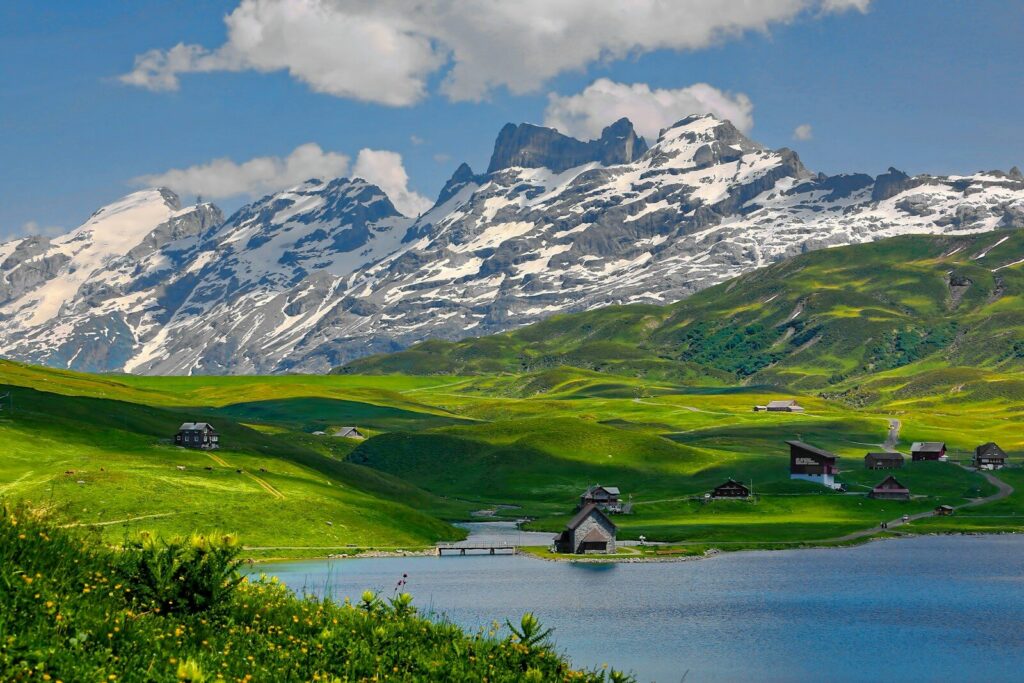
Moving to Switzerland from Canada can provide access to one of Europe’s most stable economies, internationally respected employers, highly developed transportation systems, world-class research institutions, multilingual communities, and exceptional mountain, lake, and outdoor environments.
Switzerland is located in Central Europe and shares borders with France, Germany, Austria, Liechtenstein, and Italy. It is not a member of the European Union or European Economic Area, but it participates in the Schengen Area and has extensive bilateral agreements with the European Union.
The country uses the Swiss franc, usually abbreviated CHF, rather than the euro.
Switzerland has four national languages:
- German
- French
- Italian
- Romansh
Language and culture differ substantially by region. German is dominant across much of central, northern, and eastern Switzerland. French is widely used in western Switzerland. Italian is the principal language of the canton of Ticino and parts of Graubünden. Romansh is spoken by a smaller population in Graubünden.
Many Canadians move to Switzerland for work in finance, banking, insurance, pharmaceuticals, biotechnology, medical technology, engineering, information technology, commodities, international organizations, luxury goods, research, education, hospitality, manufacturing, or professional services.
Others relocate to join a spouse or partner, study at a Swiss university, conduct research, build a business, undertake a professional training placement, retire with sufficient resources, or experience life in one of Europe’s most distinctive countries.
Zurich is Switzerland’s largest city and a major centre for finance, technology, insurance, research, consulting, and international business. Geneva is home to international organizations, diplomatic missions, banks, commodity-trading companies, and multinational employers. Basel is one of the world’s most important pharmaceutical and life-sciences centres. Lausanne offers opportunities in education, research, technology, sport, healthcare, and international business.
Bern is the federal capital and an important centre for government, administration, healthcare, engineering, and public services. Zug is known for commodities, finance, technology, blockchain businesses, and relatively attractive taxation. Lucerne combines tourism, education, insurance, transportation, and professional services. Lugano is the principal financial and commercial centre of Italian-speaking Switzerland.
Other possible destinations include Winterthur, St. Gallen, Fribourg, Neuchâtel, Biel/Bienne, Montreux, Vevey, Nyon, Schaffhausen, Baden, Aarau, Sion, Chur, and smaller mountain or industrial communities.
Moving to Switzerland from Canada can be rewarding, but it is not a simple relocation. Switzerland maintains strict employment rules for citizens from countries outside the European Union and European Free Trade Association. Canadian citizens are treated as third-country nationals for Swiss work-permit purposes.
Swiss employers generally need to demonstrate that a Canadian worker is highly qualified and that the position could not be filled by a suitable person from Switzerland or the EU/EFTA labour market. Work permits are also subject to annual quotas.
A Canadian should therefore avoid assuming that an employment offer automatically guarantees permission to work. The employer, canton, and federal authorities all play roles in the approval process.
This guide explains the major immigration, employment, housing, registration, healthcare, tax, customs, education, transportation, and international moving considerations involved in moving to Switzerland from Canada.
Why Move to Switzerland from Canada?
Switzerland combines economic strength, political stability, public safety, advanced infrastructure, beautiful landscapes, and access to major European markets.
Common reasons Canadians consider moving to Switzerland include:
- Banking and finance
- Insurance
- Pharmaceutical employment
- Biotechnology
- Medical technology
- Engineering
- Information technology
- Scientific research
- Commodity trading
- Consulting
- International organizations
- Diplomacy
- Higher education
- Hospitality
- Luxury goods
- Family reunification
- Entrepreneurship
- Professional development
- Access to Europe
- Mountain and outdoor recreation
Switzerland is home to multinational corporations, international institutions, respected universities, advanced hospitals, research centres, precision manufacturers, pharmaceutical companies, banks, insurers, commodity traders, and technology businesses.
The country is particularly strong in:
- Pharmaceuticals
- Biotechnology
- Medical devices
- Banking
- Insurance
- Asset management
- Commodity trading
- Precision engineering
- Machinery
- Chemicals
- Food production
- Luxury goods
- Watches
- Information technology
- Cybersecurity
- Research
- Tourism
- International governance
Salaries can be high, especially in finance, pharmaceuticals, technology, engineering, and senior management. However, housing, health insurance, childcare, restaurants, transportation, personal services, and everyday expenses can also be extremely expensive.
A high salary should be evaluated according to Swiss net income and local costs rather than converted directly into Canadian dollars.
Understanding Switzerland’s Cantonal System
Switzerland is divided into 26 cantons.
Each canton has significant responsibility for matters such as:
- Immigration administration
- Taxation
- Education
- Healthcare implementation
- Police
- Housing procedures
- Professional licensing
- Social services
Federal law establishes the overall immigration framework, but cantonal authorities review and administer many applications.
Taxes differ by:
- Canton
- Municipality
- Marital status
- Family composition
- Income
- Assets
- Religious registration in some places
Health-insurance premiums also vary by canton, municipality, age, insurer, and coverage model.
A move from Zurich to Zug, Geneva to Vaud, or Basel-Stadt to Basel-Landschaft can therefore affect taxes, rent, insurance premiums, transportation, schools, and administrative procedures.
When comparing Swiss job offers, evaluate the specific canton and municipality rather than treating Switzerland as one uniform market.
Important Realities Before Moving
Switzerland can offer a very high quality of life, but newcomers should understand the challenges.
The first challenge is immigration. Canadians do not benefit from the same labour-market access as EU and EFTA citizens.
The second challenge is cost. Zurich, Geneva, Zug, Lausanne, Basel, and many nearby communities have high rents.
The third challenge is housing supply. Attractive properties can receive many applications immediately.
The fourth challenge is language. English is common in international companies, but local-language ability becomes increasingly important for government interaction, healthcare, housing, schools, community life, professional advancement, and permanent settlement.
The fifth challenge is healthcare cost. Swiss health insurance is mandatory but privately purchased. Residents generally must arrange basic insurance within three months of taking up residence or beginning work.
The sixth challenge is taxation. Swiss residents may need to declare worldwide income and assets, and wealth tax can apply at cantonal and municipal levels.
The seventh challenge is administrative variation. Procedures can differ between cantons and municipalities, so advice that applies in Geneva may not apply in Zurich or Ticino.
Choosing Where to Live in Switzerland
Before choosing a city or canton, evaluate:
- Location of employment
- Work-permit approval
- Local language
- Housing availability
- Rent
- Tax rates
- Health-insurance premiums
- Commute
- Public transportation
- Schools
- Childcare
- Airport access
- Need for a vehicle
- Long-term career prospects
Many professionals choose housing outside the city where they work.
A Zurich employee might live in Winterthur, Baden, Uster, Dübendorf, Thalwil, Horgen, Wädenswil, or another connected municipality.
A Geneva employee may live in Carouge, Lancy, Meyrin, Versoix, Nyon, Lausanne, or a nearby French border community. Cross-border residence, however, creates additional immigration, tax, insurance, payroll, and commuting considerations.
A Basel employee might live in Basel-Landschaft, Aargau, Solothurn, or across the border in France or Germany. Again, cross-border arrangements require specialized advice.
Renting before purchasing is generally the safest approach.
Moving to Zurich
Zurich is Switzerland’s largest city and one of Europe’s major financial and business centres.
Its economy includes:
- Banking
- Insurance
- Asset management
- Fintech
- Technology
- Consulting
- Professional services
- Research
- Healthcare
- Education
- Media
- Engineering
- International headquarters
Major employers include banks, insurers, technology companies, universities, hospitals, consulting firms, and multinational corporations.
Popular areas include:
- Altstadt
- Enge
- Seefeld
- Wiedikon
- Wipkingen
- Oerlikon
- Altstetten
- Höngg
- Wollishofen
- Zürichberg
- Schwamendingen
The old town is central and attractive but expensive, tourist-heavy, and limited in supply.
Seefeld and Enge offer lake access and excellent transportation but command premium prices.
Wiedikon is popular with professionals and families because of its central location and residential atmosphere.
Oerlikon provides modern apartments, major employers, strong rail connections, and access to Zurich Airport.
Altstetten has extensive development, offices, rail connections, and comparatively broader housing options.
Neighbouring municipalities can offer more space, but taxes and transportation costs should be compared.
Zurich has:
- Trams
- Buses
- Suburban trains
- Regional trains
- Boats
- Cycling routes
A car is generally unnecessary for residents living near public transportation.
When viewing housing, inspect:
- Rent
- Additional charges
- Heating
- Laundry arrangements
- Storage
- Parking
- Noise
- Insulation
- Natural light
- Kitchen appliances
- Internet
- Move-in date
- Minimum lease term
Shared laundry rooms and assigned laundry schedules are common in some buildings.
Moving to Geneva
Geneva is a global centre for diplomacy, international organizations, finance, commodity trading, humanitarian work, and multinational business.
Important employers include:
- United Nations organizations
- International agencies
- Non-governmental organizations
- Banks
- Commodity traders
- Private wealth managers
- Law firms
- Consulting companies
- Luxury-goods businesses
- Research organizations
Popular areas include:
- Eaux-Vives
- Plainpalais
- Champel
- Carouge
- Servette
- Petit-Saconnex
- Nations
- Meyrin
- Lancy
- Versoix
Central Geneva is extremely expensive.
Eaux-Vives provides lake access, restaurants, shopping, and urban convenience.
Champel is residential and attractive to families and professionals.
Carouge has a distinctive historic character and strong tram access.
The Nations area is convenient for international-organization employees.
Meyrin can appeal to workers employed near the airport, research facilities, industrial sites, or international organizations.
The Geneva region is highly international, and English is widely used in some workplaces. French remains essential for broader employment and daily integration.
Geneva has:
- Trams
- Buses
- Trains
- Boats
- Regional connections
- Airport access
Cross-border residence in France may appear more affordable but involves legal, tax, healthcare, and commuting complexities.
Moving to Basel
Basel is a major pharmaceutical, chemical, biotechnology, logistics, and life-sciences centre.
Its economy includes:
- Pharmaceuticals
- Biotechnology
- Chemicals
- Medical technology
- Research
- Finance
- Logistics
- Art
- Education
- Healthcare
Basel sits near both France and Germany, creating a tri-national regional economy.
Popular areas include:
- Grossbasel
- Kleinbasel
- St. Alban
- Gundeldingen
- Iselin
- Bruderholz
- Riehen
- Binningen
- Allschwil
St. Alban is attractive and residential.
Gundeldingen provides access to the main rail station and city centre.
Kleinbasel offers lively neighbourhoods and Rhine access.
Riehen, Binningen, and Allschwil can appeal to families seeking quieter environments.
Many pharmaceutical and research employees work in English, but German is important for broader employment and local life. Swiss German is commonly spoken socially, while Standard German is used in writing and formal communication.
Moving to Lausanne
Lausanne is located on Lake Geneva in the canton of Vaud.
Its economy includes:
- Education
- Research
- Technology
- Healthcare
- Finance
- International sport
- Hospitality
- Professional services
The city is home to respected universities and research institutions.
Lausanne is built on steep terrain. A neighbourhood that appears close on a map may involve significant elevation.
Popular areas include:
- Centre
- Ouchy
- Sous-Gare
- Chailly
- Pully
- Prilly
- Renens
- Lutry
Ouchy offers lake access and premium rents.
Sous-Gare is popular because of its transportation and central location.
Pully and Lutry offer residential environments east of the city.
Renens has major rail connections and may provide somewhat broader housing options.
French is the principal local language.
Moving to Bern
Bern is Switzerland’s federal capital.
Its economy includes:
- Federal government
- Public administration
- Healthcare
- Education
- Engineering
- Telecommunications
- Transportation
- Professional services
Bern has a historic centre, strong public transportation, access to nature, and a more relaxed atmosphere than Zurich or Geneva.
Popular areas include:
- Altstadt
- Kirchenfeld
- Breitenrain
- Länggasse
- Mattenhof
- Bümpliz
- Köniz
- Ostermundigen
German is the principal written language, while Bernese Swiss German is widely spoken.
Public-sector jobs often require strong German or French skills and may impose nationality or security requirements.
Moving to Zug
Zug is known for:
- Commodity trading
- Finance
- Technology
- Blockchain businesses
- Corporate headquarters
- Professional services
- Attractive cantonal taxation
Zug is located between Zurich and Lucerne and has excellent rail connections.
Housing is expensive and limited because of strong demand.
Popular communities include:
- Zug
- Baar
- Cham
- Rotkreuz
- Hünenberg
- Steinhausen
Zug may suit senior professionals, executives, finance employees, technology workers, and commodity traders.
A lower tax rate does not automatically produce lower overall living costs because rent and property prices can be very high.
Moving to Lucerne
Lucerne is located in central Switzerland and is known for:
- Tourism
- Hospitality
- Insurance
- Transportation
- Education
- Healthcare
- Professional services
- Manufacturing
The city offers lake and mountain access and strong rail connections to Zurich, Bern, and Basel.
German is the principal local language.
Housing in the central city and lakeside communities can be expensive.
Moving to Lugano and Ticino
Lugano is the principal business centre of Italian-speaking Switzerland.
Its economy includes:
- Banking
- Finance
- Tourism
- Healthcare
- Education
- Construction
- Trade
- Professional services
Italian is essential for most local employment.
The climate is milder than in much of Switzerland, with hot summers and relatively mild winters.
Other Ticino communities include:
- Bellinzona
- Locarno
- Mendrisio
- Chiasso
Cross-border employment and commuting with Italy are common, but Canadians should obtain advice before considering such arrangements.
Moving to St. Gallen
St. Gallen is an important centre for:
- Education
- Insurance
- Manufacturing
- Textiles
- Healthcare
- Professional services
- Regional administration
The city may offer lower housing costs than Zurich while maintaining good rail access.
German and Swiss German are important.
Moving to Neuchâtel
Neuchâtel is associated with:
- Watchmaking
- Microtechnology
- Electronics
- Research
- Pharmaceuticals
- Education
- Precision manufacturing
French is the principal language.
The surrounding region includes important industrial and research employers.
Moving to Biel/Bienne
Biel/Bienne is officially bilingual in German and French.
It is known for:
- Watchmaking
- Precision manufacturing
- Machinery
- Communications
- Regional services
The city can appeal to professionals who want a bilingual environment and somewhat lower housing costs than Zurich or Geneva.
Moving to Mountain and Resort Communities
Employment may be available in:
- Hospitality
- Tourism
- Ski operations
- Property management
- Construction
- Healthcare
- Transportation
- Retail
Popular resort areas can have extremely high housing costs and limited year-round supply.
Seasonal employment may not provide the same long-term immigration pathway as highly qualified permanent employment.
Can Canadians Visit Switzerland Without a Visa?
Canadian citizens can generally enter Switzerland and other Schengen countries for short visits of up to 90 days within any 180-day period without a short-stay visa.
This applies to tourism, family visits, and limited business activities.
It does not provide a general right to:
- Work
- Operate a local business
- Settle permanently
- Study long term
- Remain indefinitely
Third-country nationals entering for a short stay must hold a recognized travel document and satisfy Schengen entry conditions.
Long-term stays are subject to authorization and may require a national type-D visa depending on the person’s nationality, status, and approved residence category.
Work Permits for Canadians
As a Canadian citizen, you are considered a third-country national for Swiss employment purposes.
Swiss authorities generally admit third-country workers only when they are highly qualified.
Potentially qualifying applicants include:
- Senior managers
- Specialists
- Professionals with university degrees
- Employees with extensive specialized experience
- Scientists
- Researchers
- Engineers
- Technology specialists
- Pharmaceutical professionals
- Executives
- Highly skilled technical workers
The employer normally leads the permit application.
The employer must generally demonstrate that:
- The position requires specialized qualifications
- The Canadian applicant has the required education or experience
- No suitable Swiss or EU/EFTA candidate was available
- Salary and conditions are customary for the occupation and region
- The application serves Swiss economic interests
- A permit quota is available
Foreign nationals may not work in Switzerland without authorization, and the rules for Canadians differ from the rules applying to EU and EFTA citizens.
Labour-Market Priority
Swiss and EU/EFTA workers receive priority for many positions.
The employer may need to show evidence of recruitment efforts, including:
- Job advertisements
- Candidate searches
- Recruitment records
- Explanations of rejected applicants
- Specialized role requirements
A generic job description may not be sufficient.
The strongest Canadian applicants usually possess qualifications or experience that are genuinely difficult to find in the Swiss and European labour market.
Permit Quotas
Swiss work permits for third-country nationals are subject to annual quantitative limits.
The existence of a qualifying job does not guarantee that a permit will be available.
Applications are reviewed by cantonal authorities and, in many cases, the State Secretariat for Migration.
Employers should plan permit applications well before the proposed start date.
L Permits
The L permit is generally a short-term residence permit.
It may be issued for:
- Fixed-term employment
- Assignments
- Projects
- Training
- Temporary professional activities
The permit is usually tied to the approved employment and duration.
Changing employer, canton, or occupation can require authorization.
Time spent on an L permit may be treated differently from time spent on a B permit for long-term settlement purposes.
B Permits
The B permit is a residence permit generally used for longer stays.
For a Canadian employee, it can be linked to:
- Employment
- Employer
- Canton
- Permit conditions
- Annual renewal
A B permit does not automatically provide unrestricted access to the entire Swiss labour market.
Changing jobs or cantons may require prior approval.
C Permits
The C permit is the Swiss settlement permit.
It provides more stable residence and is not subject to the same time restrictions as temporary permits.
Settlement can generally be considered after five or ten years, depending on nationality, agreements, integration, and individual circumstances.
Canadians should normally plan on the standard long-term qualifying period unless a specific treaty, family relationship, or accelerated-integration rule applies.
Requirements can include:
- Continuous lawful residence
- Language ability
- Integration
- Respect for public order
- Financial independence
- No significant social-assistance dependence
- Compliance with tax obligations
- No serious criminal record
Young Professionals Program
Canada and Switzerland participate in a young-professionals arrangement.
The program allows eligible young Canadians who have completed appropriate education or vocational training to obtain temporary authorization for professional development in Switzerland.
The Swiss government states that eligible Canadians with at least a bachelor’s degree or a two-year apprenticeship can obtain a work permit for a professional placement lasting up to 18 months.
The program can be useful for:
- Recent graduates
- Apprenticeship graduates
- Early-career professionals
- Language development
- International work experience
The position generally must relate to the applicant’s education or professional development.
This is a temporary route rather than a guaranteed path to permanent residence.
Intra-Company Transfers
A Canadian employee of a multinational corporation may be transferred to a Swiss office.
Potential transferees include:
- Senior managers
- Executives
- Specialists
- Technical experts
- Project leaders
The employer still needs to obtain authorization.
A long history with the company, specialized internal knowledge, seniority, and a clearly defined assignment can strengthen the application.
International Organizations
Geneva and other Swiss cities host international organizations, diplomatic missions, and related institutions.
Employees can have special residence documents or privileges depending on the organization and role.
Employment with an international organization does not always create the same immigration, tax, social-security, permanent-residence, or citizenship rights as ordinary Swiss employment.
Ask the organization to explain:
- Residence status
- Work authorization
- Family status
- Tax treatment
- Social insurance
- Healthcare
- Pension
- Long-term settlement implications
Self-Employment
A Canadian who wants to establish a business in Switzerland does not automatically qualify for residence.
Third-country entrepreneurs generally need to demonstrate that the business will have a lasting positive effect on the Swiss labour market or economy.
Evidence may include:
- Business plan
- Market analysis
- Investment
- Financing
- Job creation
- Innovation
- Customer contracts
- Revenue projections
- Professional qualifications
- Benefit to the canton
After immigration approval, the entrepreneur must also address:
- Company registration
- Commercial register
- Social insurance
- Accident insurance
- Occupational pension
- VAT
- Accounting
- Tax
- Banking
- Licensing
Swiss guidance explains that self-employed people must arrange appropriate social and health insurance and may need to register for VAT when the applicable turnover threshold is exceeded.
Opening a Swiss company does not itself create a right to live in Switzerland.
Remote Work and Digital Nomads
Switzerland does not offer a general digital-nomad visa.
A Canadian normally cannot move to Switzerland permanently solely because they work online for a Canadian company.
The person needs another lawful residence basis, such as:
- Swiss employment
- Family reunification
- Study
- Approved self-employment
- Residence without gainful activity
- Another recognized category
Remote work from Switzerland can create:
- Swiss income-tax obligations
- Social-security obligations
- Payroll requirements
- Employer-registration duties
- Employment-law issues
- Permanent-establishment exposure
Payment into a Canadian bank account does not prevent Swiss taxation or immigration rules from applying.
Living in Switzerland Without Working
Some third-country nationals can obtain residence without gainful employment, but requirements are strict.
Possible applicants include:
- Students
- Pensioners
- People of independent means
- Individuals receiving medical treatment
- Other approved categories
Applicants generally need:
- Sufficient financial resources
- Comprehensive health and accident insurance
- Suitable accommodation
- Cantonal approval
- No reliance on social assistance
Swiss official guidance confirms that foreign nationals living without gainful employment must have adequate insurance and sufficient resources.
A wealthy Canadian cannot assume that financial resources alone guarantee residence.
Cantonal requirements, age, connections to Switzerland, taxation arrangements, and public interest may all matter.
Student Residence Permits
Canadians accepted by a recognized Swiss institution can apply for student residence.
Requirements may include:
- Admission letter
- Study plan
- Proof of funds
- Accommodation
- Health insurance
- Academic records
- Written commitment to leave after studies where required
- Passport
- Cantonal approval
Switzerland has respected institutions in:
- Zurich
- Lausanne
- Geneva
- Basel
- Bern
- St. Gallen
- Fribourg
- Neuchâtel
- Lugano
- Lucerne
International students should confirm:
- Tuition
- Living expenses
- Work limitations
- Language
- Academic requirements
- Housing
- Health insurance
- Post-study employment possibilities
Study residence does not provide unrestricted work rights.
Family Reunification
A Canadian may qualify to join a spouse, registered partner, parent, or other qualifying family member living in Switzerland.
Eligibility depends on the sponsor’s:
- Citizenship
- Permit type
- Relationship
- Income
- Housing
- Family circumstances
Potentially qualifying family members include:
- Spouse
- Registered partner
- Minor children
- Other dependent relatives in limited situations
Requirements can include:
- Genuine relationship
- Suitable housing
- Financial resources
- Health insurance
- Civil-status documents
- Language preparation
- No significant social-assistance risk
Health insurance is mandatory for each family member.
Unmarried Partners
Switzerland does not automatically treat every Canadian common-law relationship as equivalent to marriage.
An unmarried Canadian partner may have difficulty qualifying for ordinary family reunification unless another legal basis applies.
Couples may need to consider:
- Marriage
- Registered partnership where legally applicable
- Independent employment permit
- Study permit
- Another residence category
Do not assume that years of cohabitation in Canada automatically create Swiss family-reunification rights.
Permanent Residence
Permanent settlement is usually associated with the C permit.
Eligibility can depend on:
- Nationality
- Length of residence
- Permit history
- Integration
- Language
- Public-order compliance
- Financial independence
- Tax compliance
Swiss settlement permits may be available after five or ten years, depending on the person’s legal circumstances.
Time spent as a student, short-term worker, international-organization employee, or temporary resident may not always count in the same manner.
Extended absences can interrupt residence.
Swiss Citizenship
Swiss citizenship can be acquired through descent, adoption, ordinary naturalization, or facilitated naturalization in qualifying circumstances.
Ordinary naturalization generally involves:
- Long-term lawful residence
- C permit
- Language ability
- Integration
- Familiarity with Swiss life
- Respect for public order
- Financial responsibility
- Cantonal and municipal requirements
Swiss naturalization has federal, cantonal, and municipal components.
Applicants may face:
- Interviews
- Language certification
- Civics questions
- Local-residence requirements
- Review of tax and debt records
- Community-integration assessment
Switzerland permits dual citizenship, and Canada also permits dual citizenship.
Spouses of Swiss citizens may qualify for facilitated naturalization when the applicable marriage, residence, and integration requirements are met.
Preparing Canadian Documents
Begin document preparation several months before relocation.
Possible documents include:
- Passport
- Birth certificate
- Marriage certificate
- Divorce judgment
- Criminal-record check
- University diploma
- College diploma
- Transcripts
- Trade certificate
- Professional licence
- Employment references
- Employment contract
- Business records
- Custody documents
- School records
Documents may require:
- Apostille
- Certified translation
- Original copy
- Certified copy
- Recent issue date
Canada has participated in the Apostille Convention since January 2024.
The responsible Canadian apostille authority depends on where the document was issued or notarized.
Translations may need to be completed in the language required by the canton.
Keep:
- Originals
- Apostilles
- Translations
- Paper copies
- Digital scans
- Application receipts
Registering After Arrival
New residents generally need to register with the local commune.
Registration procedures differ by municipality and canton.
Swiss official guidance states that residents are generally expected to register with the new commune within 14 days of moving.
New foreign workers are often required to register before beginning work.
Possible documents include:
- Passport
- Residence authorization
- Employment contract
- Lease
- Birth certificate
- Marriage certificate
- Passport photographs
- Health-insurance evidence
- Application forms
Confirm the exact deadline with the commune before arrival.
How Much Does It Cost to Move to Switzerland from Canada?
The total cost depends on:
- Canadian departure city
- Swiss destination
- Family size
- Permit type
- Shipment volume
- Housing
- Health insurance
- Childcare
- Pets
- Vehicles
- Schooling
- Professional advice
Possible expenses include:
- Permit fees
- Visa fees
- Criminal-record checks
- Apostilles
- Translations
- Flights
- International movers
- Export packing
- Sea freight
- Air freight
- Customs clearance
- Storage
- Temporary housing
- Rental deposit
- Advance rent
- Health insurance
- Liability insurance
- Pet relocation
- Vehicle costs
- International-school tuition
- Emergency savings
Zurich, Geneva, Zug, Lausanne, and Basel generally require substantial housing budgets.
A rental deposit can equal several months of rent and is commonly placed in a blocked deposit account.
Shipping Household Goods to Switzerland
Switzerland is landlocked.
A sea shipment from Canada typically enters Europe through a major port and continues to Switzerland by road or rail.
Potential gateways include:
- Rotterdam
- Antwerp-Bruges
- Hamburg
- Bremerhaven
- Genoa
- Another European port
The exact route depends on:
- Canadian origin
- Shipping line
- Mover
- Container service
- Swiss destination
- Consolidation schedule
Possible shipping services include:
- Shared-container shipping
- Full-container shipping
- Air freight
- Excess baggage
- Courier shipping
- Storage
- Vehicle transport
- Door-to-door delivery
Shared-Container Shipping
Shared-container shipping allows several customers to use one container.
You pay according to the volume occupied by your belongings.
This can suit:
- Apartment moves
- Smaller households
- Students
- Retirees
- Partial relocations
- Furnished-home moves
The disadvantage is timing.
The mover may wait for sufficient cargo before dispatch.
Ask:
- How often containers depart
- Where consolidation occurs
- Whether goods are transferred
- When transit time begins
- Which European port is used
- Whether Swiss customs is included
- Whether inland delivery is included
- Whether storage is included
Full-Container Shipping
A dedicated container may suit:
- Families
- Larger homes
- Extensive furniture
- Significant personal belongings
- Customers seeking more control
Common sizes include 20-foot and 40-foot containers.
A professional survey should determine required volume.
Decluttering before packing can reduce:
- Packing labour
- Materials
- Freight
- Insurance
- Storage
- Final delivery
Air Freight
Air freight is faster but more expensive.
It may be suitable for:
- Work equipment
- Computers
- Essential clothing
- Medical supplies
- Children’s necessities
- Time-sensitive possessions
Many households travel with essential luggage, send a limited air shipment, and move the main household contents by sea.
What Should You Ship?
Swiss homes are often smaller than Canadian houses.
Before shipping furniture, assess:
- Room dimensions
- Door widths
- Staircases
- Elevator size
- Storage
- Building access
- Electrical compatibility
- Replacement cost
Items often worth shipping include:
- Sentimental possessions
- Artwork
- High-quality furniture
- Books
- Clothing
- Heirlooms
- Professional equipment
- Children’s belongings
- Collections
- Outdoor equipment
Items often better sold or donated include:
- Oversized sectional furniture
- Large Canadian appliances
- Old electronics
- Low-value furniture
- Damaged goods
- Electrically incompatible equipment
Switzerland uses European voltage and Swiss plug standards.
Some European plugs work in certain Swiss outlets, but not every plug format is identical.
A plug adapter does not convert voltage.
Professional Export Packing
International shipments undergo multiple stages of handling.
Professional packing can include:
- Double-walled cartons
- Furniture wrapping
- Mattress covers
- Moisture protection
- Wardrobe cartons
- Foam
- Reinforced tape
- Corner protection
- Custom crates
Artwork, mirrors, antiques, instruments, stone, and high-value electronics may require custom crating.
Ask how owner-packed cartons affect insurance.
Customs Relief for Moving Goods
Used household goods imported during a genuine move from Canada to Switzerland can generally qualify for relief from import duties and taxes when the conditions are satisfied.
Qualifying relocation goods usually need to have been used personally before the move and remain intended for continued personal use after import.
The importer may need to demonstrate:
- Genuine transfer of residence
- Prior use and possession
- New Swiss residence
- Accurate inventory
- Appropriate customs declaration
- Import within the permitted period
Your mover or customs representative may request:
- Passport
- Swiss residence authorization
- Employment contract
- Lease
- Proof of Canadian residence
- Detailed inventory
- Shipping documents
- Customs form
- Authorization for representation
- Vehicle documents where applicable
New goods, commercial stock, alcohol, tobacco, food, and restricted goods can receive different treatment.
Customs Inventory
Prepare a detailed numbered inventory.
Avoid vague descriptions such as:
- Miscellaneous
- Household effects
- Personal items
- Various goods
Use clear descriptions such as:
- Used clothing
- Books
- Kitchen utensils
- Bedding
- Used tableware
- Children’s toys
- Framed photographs
- Office records
- Used furniture
- Ski equipment
- Bicycles
List high-value items separately.
Record serial numbers.
Take photographs before packing.
Keep receipts and appraisals.
Restricted and Prohibited Goods
Do not pack hazardous or prohibited items.
Restricted categories may include:
- Firearms
- Ammunition
- Explosives
- Fireworks
- Fuel
- Gas cylinders
- Chemicals
- Paint
- Aerosols
- Illegal drugs
- Certain medicines
- Plants
- Seeds
- Soil
- Meat
- Dairy
- Protected wildlife products
- Counterfeit goods
Food and products derived from protected species can be subject to additional customs and animal-health restrictions.
Medication should generally travel with you in original packaging.
Bring prescriptions and a physician’s letter where appropriate.
Importing a Canadian Vehicle
Importing a Canadian vehicle can involve:
- Shipping
- Customs
- VAT
- Automobile tax
- Technical inspection
- Registration
- Modifications
- Insurance
- Licence plates
- Cantonal road tax
A relocation exemption may apply when the vehicle qualifies as used household property and satisfies ownership and use requirements.
However, registration and technical compliance remain necessary.
A Canadian vehicle may need modifications involving:
- Headlights
- Turn signals
- Rear fog lights
- Speedometer
- Emissions equipment
- Safety systems
Before shipping, obtain written estimates for:
- Freight
- Customs
- Inspection
- Modifications
- Registration
- Insurance
- Annual road tax
Selling the vehicle in Canada and purchasing one in Switzerland can be simpler.
Public transportation makes car ownership unnecessary in many cities.
Moving Pets to Switzerland
Dogs, cats, and ferrets entering Switzerland must satisfy animal-health and identification rules.
Common requirements include:
- Microchip
- Valid rabies vaccination
- Veterinary documentation
- Entry declaration
- Appropriate border procedure
- Airline-compliant crate
Swiss authorities advise pet owners to complete the required formalities well in advance.
Canada is listed among countries with a favourable rabies-risk profile, but travellers must still follow the applicable entry requirements.
Use the official Swiss pet-entry checker for the animal, country of origin, age, vaccination history, and purpose of import.
After arrival, dog owners may need to:
- Register the dog
- Notify the commune
- Visit a veterinarian
- Enter the animal in the national database
- Pay dog tax
- Complete training where required
- Obtain liability insurance where required
When changing communes, dog owners generally need to notify both the previous and new commune.
International Moving Insurance
Marine transit insurance can protect eligible household goods during transportation.
Coverage can include:
- Total-loss insurance
- Declared-value insurance
- Replacement-value insurance
- High-value item coverage
- Limited owner-packed coverage
Review:
- Deductible
- Valuation method
- Exclusions
- Storage coverage
- Moisture exclusions
- Claims deadline
- Evidence requirements
Do not ship:
- Passports
- Cash
- Jewellery
- Medication
- Financial instruments
- Irreplaceable documents
Finding Housing in Switzerland
The rental market is highly competitive in major cities.
Landlords may request:
- Passport
- Residence permit
- Employment contract
- Salary confirmation
- Debt-enforcement register extract
- References
- Application form
- Deposit
Newcomers without Swiss records may need to provide:
- Employer letter
- Canadian bank statements
- Relocation-company support
- Additional references
- Proof of savings
Prepare a rental application package in advance.
Rental Deposits
Rental deposits are commonly placed in a blocked bank account in the tenant’s name.
Do not transfer a large deposit directly to an unverified landlord or agent.
Before paying:
- Verify ownership
- Confirm the agent
- Inspect the property
- Review the lease
- Confirm deposit arrangements
- Document condition
- Record meter readings
- Obtain receipts
Additional Rental Charges
Swiss rental listings may separate:
- Net rent
- Additional charges
- Heating
- Hot water
- Building expenses
- Parking
Clarify what is included.
Electricity, internet, household insurance, and other services may be separate.
Handover Inspection
The move-in inspection is important.
Document:
- Walls
- Floors
- Windows
- Appliances
- Bathroom fixtures
- Kitchen
- Balcony
- Storage
- Keys
- Meter readings
Take photographs and ensure defects are recorded in the handover report.
Tenants can be held responsible for damage not documented at move-in.
Rental Scams
Warning signs include:
- Rent far below market
- Landlord claiming to be abroad
- Refusal to arrange a viewing
- Pressure to transfer money
- Cryptocurrency payment
- No written lease
- Foreign bank account without explanation
- Copied photographs
- Refusal to provide identification
Verify the property, landlord, agent, and payment instructions.
Buying Property in Switzerland
Property purchase rules for non-Swiss residents can be restrictive.
A Canadian with lawful Swiss residence may be able to purchase a principal home, but rules depend on:
- Permit type
- Residence
- Property use
- Canton
- Municipality
- Federal restrictions
Purchasing property does not create residence rights.
Foreigners buying vacation or investment property can face additional restrictions.
Use:
- Independent lawyer
- Notary
- Mortgage adviser
- Tax adviser
- Building inspector
Investigate:
- Ownership
- Easements
- Mortgages
- Zoning
- Building permits
- Renovation restrictions
- Structural condition
- Heating
- Energy efficiency
- Common charges
- Reserve funds
- Tax consequences
Healthcare in Switzerland
Swiss health insurance is mandatory but purchased from private insurers.
Residents generally need to obtain basic health insurance within three months of arrival or beginning work.
Basic insurance is standardized by law, but premiums differ according to:
- Canton
- Municipality
- Age
- Insurer
- Deductible
- Insurance model
- Accident coverage
Each family member requires an individual policy.
The system includes:
- General practitioners
- Specialists
- Hospitals
- Prescriptions
- Maternity care
- Emergency services
- Preventive services
Costs can include:
- Monthly premium
- Annual deductible
- Co-insurance
- Hospital contributions
- Services not covered by basic insurance
Supplementary insurance can cover private hospital rooms, alternative therapies, enhanced dental benefits, and other extras.
Supplementary insurers can assess health history and reject applications.
Accident Insurance
Employees working a sufficient number of hours for one employer are generally covered for occupational and non-occupational accidents through the employer’s accident insurance.
If accident coverage is provided through employment, it may be removed from the individual health-insurance policy to reduce premiums.
Confirm before changing coverage.
Canadian Provincial Healthcare
Do not assume Canadian provincial healthcare remains active after permanent relocation.
Each province has residency and absence rules.
Contact your provincial health authority before departure.
Travel insurance is not a substitute for mandatory Swiss health insurance.
Taxes When Moving to Switzerland
Switzerland has federal, cantonal, and municipal taxation.
Tax burden varies substantially by location.
Swiss tax residence can depend on:
- Residence
- Time spent in Switzerland
- Employment
- Family
- Permanent home
- Centre of vital interests
- Treaty rules
Swiss residents can be required to declare worldwide income and assets.
Official Swiss guidance states that tax returns can include employment income, self-employment income, investment income, real estate, securities, cash, bank balances, and certain insurance values.
Relevant Canadian interests can include:
- Salary
- Rental property
- Pensions
- Interest
- Dividends
- Capital gains
- Corporations
- Trusts
- Registered accounts
- Cryptocurrency
- Real estate
Canada and Switzerland have a bilateral tax treaty designed to allocate taxing rights and reduce double taxation.
The treaty does not eliminate every filing or disclosure requirement.
Canadians leaving Canada should consider:
- Departure date
- Residential ties
- Departure tax
- Canadian real estate
- Registered accounts
- Pensions
- Investments
- Corporations
- Trusts
- Non-resident withholding
- Provincial obligations
Use advisers experienced in both Canadian and Swiss taxation.
Tax at Source
Many foreign employees without a C permit have Swiss income tax deducted directly from salary.
This is known as tax at source.
Depending on income, assets, residence, deductions, and canton, the employee may also need or choose to file an ordinary tax return.
Do not assume payroll withholding completes every tax obligation.
Wealth Tax
Cantons and municipalities generally levy annual wealth tax on qualifying net assets.
Potential assets include:
- Bank accounts
- Investments
- Securities
- Foreign property
- Valuable collections
- Business interests
- Certain insurance values
Debts can often be deducted under applicable rules.
Canadian newcomers with significant assets should obtain planning advice before becoming Swiss resident.
Remote Work and Swiss Tax
Working remotely from Switzerland for a Canadian employer can create:
- Swiss income tax
- Canadian income tax
- Payroll obligations
- Social-security obligations
- Employment-law exposure
- Employer-registration requirements
- Permanent-establishment risk
Payment into Canada does not prevent Swiss taxation.
A Canadian employer may need Swiss payroll or legal support.
Social Security
Swiss employment generally brings participation in the Swiss social-insurance system.
Possible contributions include:
- Old-age and survivors’ insurance
- Disability insurance
- Income compensation
- Unemployment insurance
- Occupational pension
- Accident insurance
Canada and Switzerland have social-security coordination arrangements that can affect pension eligibility and temporary assignments.
Transferred workers should determine whether a certificate of coverage is appropriate.
Opening a Swiss Bank Account
A Swiss bank account is useful for:
- Salary
- Rent
- Insurance
- Utilities
- Tax
- Local transfers
- Debit card
- Mobile payments
Banks may request:
- Passport
- Residence permit
- Swiss address
- Employment contract
- Tax identification information
- Source-of-funds evidence
Keep a Canadian account for pensions, investments, property, and continuing obligations.
Working in Switzerland
Switzerland offers employment in:
- Banking
- Insurance
- Pharmaceuticals
- Biotechnology
- Medical devices
- Engineering
- Information technology
- Commodity trading
- Consulting
- Research
- International organizations
- Luxury goods
- Hospitality
- Manufacturing
- Healthcare
- Education
English-speaking positions are most common in:
- Multinational companies
- Research
- Pharmaceuticals
- Technology
- Finance
- Commodity trading
- International organizations
Local-language ability significantly expands opportunities.
Swiss Workplace Culture
Common characteristics include:
- Punctuality
- Precision
- Preparation
- Professionalism
- Privacy
- Reliability
- Structured decision-making
- Respect for qualifications
- Clear separation of work and personal life
Communication styles vary by language region and employer.
A German-speaking engineering firm may operate differently from a Geneva international organization or a Ticino family business.
Professional Credential Recognition
Regulated professions may require formal recognition.
This can apply to:
- Doctors
- Nurses
- Dentists
- Pharmacists
- Psychologists
- Teachers
- Lawyers
- Architects
- Engineers in regulated contexts
- Physiotherapists
- Skilled trades
Applicants may need:
- Diploma
- Transcripts
- Course descriptions
- Professional registration
- Employment references
- Apostilles
- Translations
- Examinations
- Local-language evidence
- Supervised practice
Immigration permission does not automatically authorize professional practice.
Learning the Local Language
Language choice depends on location.
In Zurich, Basel, Bern, Zug, Lucerne, St. Gallen, and much of central Switzerland, newcomers typically study Standard German.
Swiss German dialects are spoken socially but are rarely the starting point for formal study.
In Geneva, Lausanne, Neuchâtel, Jura, and much of western Switzerland, newcomers study French.
In Ticino, Italian is essential.
Language ability improves:
- Employment
- Healthcare
- Housing
- Schools
- Government interaction
- Social integration
- Permanent residence
- Citizenship
Moving with Children
Switzerland offers:
- Public schools
- Private schools
- International schools
- Bilingual schools
- Vocational education
- Universities
Public schools operate in the local cantonal language.
International schools are available in Zurich, Geneva, Lausanne, Basel, Bern, Zug, Lugano, and other international centres.
Tuition can be extremely high.
Bring:
- Birth certificates
- Passports
- Vaccination records
- School reports
- Transcripts
- Special-education documents
- Custody records
School placement depends on:
- Canton
- Municipality
- Address
- Age
- Language
- Availability
Childcare
Childcare can be expensive and places may be limited.
Options include:
- Daycare
- Nursery
- Childminders
- After-school care
- Private nannies
- International childcare
Apply early.
Childcare subsidies vary by canton, municipality, family income, and provider.
Swiss family allowances provide minimum monthly amounts, although cantons and employers may pay more.
Transportation
Switzerland has one of the world’s most developed public transportation systems.
Options include:
- Intercity trains
- Regional trains
- Suburban rail
- Trams
- Buses
- Boats
- Mountain railways
- Cable cars
- Funiculars
Many cities operate integrated regional fare systems.
National and regional travel passes can reduce costs for frequent travellers.
A car is unnecessary in many urban areas.
Driving in Switzerland
Canadians should verify current licence-exchange rules for their province and canton.
Requirements can depend on:
- Province
- Residence status
- Exchange deadline
- Eye test
- Documents
- Practical examination
- Licence category
Driving expenses include:
- Vehicle purchase
- Insurance
- Registration
- Cantonal road tax
- Fuel
- Parking
- Motorway vignette
- Maintenance
- Winter tyres
Parking in Zurich, Geneva, Basel, and Lausanne can be expensive and limited.
Climate
Switzerland’s climate varies by altitude and region.
Lowland cities generally have:
- Cool winters
- Warm summers
- Rain throughout the year
- Occasional snow
- Heat waves
Mountain areas can have:
- Heavy snow
- Long winters
- Rapid weather changes
- Avalanche risk
- Difficult road access
Ticino has a milder, sunnier climate but can experience heavy rainfall.
Inspect housing for:
- Heating
- Insulation
- Windows
- Ventilation
- Moisture
- Mould
- Flood exposure
- Avalanche exposure
- Energy costs
Everyday Cultural Adjustment
Canadians may notice:
- Strong punctuality
- Quiet residential rules
- Detailed recycling
- Sunday restrictions
- Formal administration
- High respect for privacy
- Advance planning
- Strong local identity
- Limited spontaneous socializing
- Clean public spaces
Quiet hours can be enforced by building rules or local regulations.
Recycling requirements vary by municipality.
Friendships can take time to develop.
Joining sports clubs, language classes, professional organizations, parent groups, volunteer associations, hiking clubs, and community events can help.
A Complete Moving Timeline
Twelve Months Before Moving
Research:
- Work-permit eligibility
- Labour-market requirements
- Quotas
- Professional recognition
- Family reunification
- Cantons
- Languages
- Housing
- Tax
- Healthcare
- Schools
- Shipping
- Pets
Create a relocation budget and begin decluttering.
Nine Months Before Moving
Gather:
- Passports
- Birth certificates
- Marriage certificates
- Police records
- Diplomas
- Transcripts
- Professional licences
- Employment references
- Medical records
- School records
- Pet records
Begin learning the local language.
Six Months Before Moving
- Confirm the permit route
- Obtain tax advice
- Request moving surveys
- Arrange apostilles
- Arrange translations
- Begin credential recognition
- Prepare pets
- Research health insurance
- Research housing
- Decide what to ship
Three Months Before Moving
- Submit the residence and work application
- Confirm cantonal approval
- Select the mover
- Finalize shipment volume
- Reserve flights
- Book temporary accommodation
- Prepare customs documents
- Sell unwanted belongings
- Notify employers and schools
One Month Before Moving
- Confirm packing
- Refill prescriptions
- Back up computers
- Redirect mail
- Notify banks
- Cancel utilities
- Copy documents
- Prepare luggage
- Book commune registration
- Review customs timing
Final Week
Keep these items away from the movers:
- Passports
- Permit approval
- Employment contract
- Medication
- Money
- Jewellery
- Computers
- Chargers
- Customs documents
- School records
- Pet documents
- Travel clothing
First Week in Switzerland
- Move into temporary accommodation
- Register with the commune
- Complete residence formalities
- Obtain a Swiss phone number
- Contact the destination mover
- Begin permanent housing searches
- Review transportation
- Start health-insurance comparisons
First Three Months
- Secure permanent housing
- Complete health-insurance enrollment
- Open a bank account
- Set up utilities
- Arrange liability insurance
- Enrol children
- Register pets
- Receive the household shipment
- Establish a monthly budget
Common Mistakes to Avoid
Do not assume that visa-free entry permits employment.
Do not resign from a Canadian position before the Swiss work permit is approved.
Do not assume a job offer guarantees a quota permit.
Do not underestimate housing costs.
Do not compare salaries only by currency conversion.
Do not ignore local-language requirements.
Do not delay mandatory health insurance.
Do not assume Canadian professional credentials are automatically recognized.
Do not ignore Swiss taxation of worldwide income and assets.
Do not ship large appliances without checking voltage and plug compatibility.
Do not import a vehicle without calculating taxes, inspection, modifications, and registration.
Do not choose international movers only by the lowest initial quotation.
Frequently Asked Questions
Can a Canadian move permanently to Switzerland?
Yes, but Canadians generally need an approved residence basis such as skilled employment, family reunification, study, self-employment, or residence without gainful activity.
Can Canadians visit Switzerland without a visa?
Canadians can generally visit Switzerland and the Schengen Area for up to 90 days in any 180-day period without a short-stay visa. This does not authorize ordinary employment.
Can Canadians work in Switzerland?
Yes, but a permit is required. Third-country nationals are generally admitted only when they are highly qualified and the employer satisfies labour-market and permit requirements.
Is it difficult for a Canadian to get a Swiss work permit?
It can be challenging because Swiss and EU/EFTA candidates receive labour-market priority and third-country permits are limited by quotas.
Can Canadians apply for the Young Professionals Program?
Yes. Eligible Canadians with appropriate education or apprenticeship training can obtain temporary professional authorization for up to 18 months.
Does Switzerland have a digital-nomad visa?
No. Remote workers require another lawful residence basis.
Can Canadians start a business?
Potentially, but the business must generally demonstrate meaningful economic benefit. Registering a company alone does not create residence rights.
Can a spouse work?
A spouse’s work rights depend on the sponsor’s permit, family-reunification approval, canton, and residence status.
How long does permanent residence take?
A C permit may be available after five or ten years, depending on nationality, integration, permit history, and individual circumstances.
Can Canadians become Swiss citizens?
Yes, after meeting residence, integration, language, and other naturalization requirements. Switzerland and Canada both allow dual citizenship.
Is health insurance mandatory?
Yes. Residents generally need to purchase basic Swiss health insurance within three months of arrival or beginning work.
Are Swiss taxes low?
It depends on the canton, municipality, income, family status, and assets. Switzerland can have competitive income-tax rates in some locations, but residents can also face wealth tax and high living costs.
Can household goods enter duty-free?
Qualifying used belongings imported during a genuine transfer of residence can generally receive relief when prior use, continued personal use, residence, documentation, and timing conditions are met.
Can Canadians buy property?
A Canadian resident may be able to buy a primary residence, but restrictions can apply according to permit type, canton, and property use. Property ownership does not provide immigration rights.
Can I bring my pet?
Yes, provided the animal satisfies Swiss identification, rabies-vaccination, documentation, and border requirements.
Do I need German, French, or Italian?
English may be sufficient in selected international workplaces, but the local language is extremely valuable for housing, healthcare, schools, government services, broader employment, permanent settlement, and citizenship.
Choosing International Movers from Canada to Switzerland
An experienced international moving company can coordinate:
- In-home or virtual survey
- Shipment-volume calculation
- Export packing
- Furniture disassembly
- Custom crating
- Shared-container shipping
- Full-container shipping
- Air freight
- Marine insurance
- Canadian storage
- Swiss storage
- Customs documentation
- European port handling
- Inland transportation
- Final delivery
- Furniture reassembly
- Unpacking
- Packing-material removal
Choose a mover with direct experience transporting household goods from Canada to landlocked European destinations.
Ask:
- Is the estimate based on a professional survey?
- What volume has been calculated?
- Is export packing included?
- Is the shipment shared or dedicated?
- Which European port will be used?
- Are port charges included?
- Who handles Swiss customs clearance?
- Is inland transportation included?
- Are stairs included?
- Are long carries included?
- Is a shuttle required?
- Is an external furniture lift required?
- Are parking permits included?
- Is storage available?
- What insurance is offered?
- Who is the Swiss destination agent?
- How are claims processed?
Compare complete door-to-door quotations rather than only ocean freight.
Start Planning Your Move to Switzerland from Canada
Moving to Switzerland from Canada can create exceptional opportunities in finance, insurance, pharmaceuticals, biotechnology, medical technology, engineering, information technology, commodity trading, research, international organizations, luxury goods, manufacturing, and hospitality.
However, Switzerland is one of the more challenging European destinations for Canadian workers because Canadians do not receive the labour-market access granted to EU and EFTA citizens.
The relocation process should begin with immigration feasibility.
Before accepting a position, confirm:
- Whether the employer has experience sponsoring third-country nationals
- Whether the job requires highly specialized qualifications
- Whether recruitment requirements have been completed
- Which canton will process the application
- Whether a quota is available
- Which permit is expected
- Whether family members can accompany you
- Whether the permit is tied to the employer
- What happens if employment ends
- Whether the permit supports long-term settlement
Prepare a complete relocation budget covering:
- Permit fees
- Document preparation
- Apostilles
- Translations
- Flights
- International shipping
- Customs
- Temporary accommodation
- Rental deposit
- Health insurance
- Taxes
- Childcare
- Pets
- Vehicles
- Schools
- Emergency savings
Choose your destination according to employment, language, taxation, housing, transportation, schools, and daily life.
Zurich offers the broadest finance, insurance, technology, consulting, and professional-services market. Geneva is ideal for international organizations, diplomacy, finance, humanitarian work, commodity trading, and global institutions. Basel is one of the world’s leading pharmaceutical and life-sciences centres. Lausanne offers education, research, technology, healthcare, and international sport.
Bern provides government, healthcare, telecommunications, and public-sector opportunities. Zug attracts commodity traders, finance professionals, technology companies, and international headquarters. Lugano serves as the main commercial centre of Italian-speaking Switzerland. Neuchâtel and Biel/Bienne offer opportunities in watchmaking, precision engineering, research, and manufacturing.
Rent before purchasing whenever possible.
Inspect heating, insulation, windows, moisture, laundry arrangements, storage, service charges, parking, and public transportation.
Reduce your household shipment before confirming the final quotation.
Measure furniture, verify voltage and plug compatibility, and avoid paying to transport belongings that will not fit or function.
Prepare customs documents carefully.
Qualifying used personal property can generally receive relief when imported as part of a genuine transfer of residence, but the customs inventory, proof of residence, employment or permit documents, ownership history, and timing must be correct.
Whether you are moving from Toronto to Zurich, Vancouver to Geneva, Calgary to Basel, Montreal to Lausanne, Ottawa to Bern, Edmonton to Zug, Winnipeg to Lucerne, or Halifax to Lugano, early preparation can reduce delays, stress, and unexpected costs.
A move to Switzerland may involve strict work-permit requirements, annual quotas, labour-market priority, multilingual administration, high housing deposits, mandatory private health insurance, worldwide tax reporting, cantonal wealth tax, customs declarations, and unfamiliar rental procedures.
These challenges become more manageable when you use current official guidance, maintain organized records, obtain qualified immigration and tax advice, and choose international movers with proven experience handling Canadian-to-Swiss relocations.
With an approved residence and work permit, lawful employment, suitable housing, local registration, mandatory health insurance, careful tax planning, complete customs documentation, and a dependable international moving company, you can complete your move from Canada to Switzerland with confidence and begin building a rewarding new life in one of Europe’s most stable and internationally connected countries.